
Freytag’s Pyramid has a reputation as a schoolroom diagram, the kind of thing you labelled in English class and promptly forgot. That reputation isn’t entirely unfair. Taught in isolation, as a diagram of shape rather than a tool for understanding story mechanics, it’s not especially useful.
But the concepts behind it, particularly rising action, the climax, and falling action, name something real about how stories build and release tension. And the five-act structure it describes maps more cleanly onto certain kinds of novels than three-act does.
Writing Desk tip: The Story Plotter includes built-in structure templates, including Five-Act, Three-Act, Save the Cat, and Hero’s Journey. Apply the five-act framework directly to your chapter outline and drag scenes into the right acts as you plan.
Who Was Freytag?
Gustav Freytag was a nineteenth-century German novelist and playwright. In 1863 he published Technique of the Drama, in which he analysed the structure of classical Greek and Shakespearean plays and identified a common five-part pattern.
He wasn’t prescribing a formula. He was describing what he observed in plays that worked: the shape of successful dramatic storytelling as it had evolved across two thousand years. The pyramid is a visualisation of that pattern.
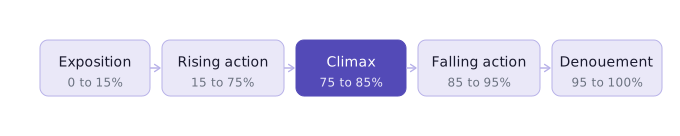
The Five Stages
1. Exposition, roughly 0 to 15%. The world before the story begins. Characters, setting, situation: everything the reader needs to enter the story and care about what happens next. The common mistake is treating exposition as a prolonged introduction. It isn’t. Exposition should be the minimum necessary to make the inciting incident mean something. Readers don’t need to understand everything before the story starts; they need enough to feel oriented, and the rest can come as the story earns it. In practice, open as close to the inciting incident as you can, and weave necessary background into the forward movement of the story.
2. Rising Action, roughly 15 to 75%. The protagonist is now engaged with the central conflict. Things get progressively more difficult. Obstacles accumulate. Each scene ends in a way that raises the stakes for the next. This is the longest section of the novel and the one most prone to losing momentum. The word “rising” is doing important work here: the action should actually rise, continuously, rather than plateau. If your rising action section feels flat, ask whether each new scene is genuinely harder than the one before, or just different.
3. Climax, roughly 75 to 85%. The peak of the pyramid. The central conflict comes to a head, the tension reaches its maximum, and a decisive moment arrives, after which the story can only move toward resolution. In Freytag’s original model, the climax sits at the midpoint of the story. In modern commercial fiction, it sits much later, typically at the 75 to 90% mark. This is one of the places where the pyramid, taken as a diagram, misleads: Freytag’s midpoint climax describes Greek and Shakespearean tragedy, not the shape of contemporary novels. What matters is that the climax is a genuine turning point, a moment of decision or confrontation from which there is no return to what came before.
4. Falling Action, roughly 85 to 95%. After the climax, tension releases. The consequences of the decisive moment play out. Loose ends begin to resolve. Characters process what happened. Falling action is the section most writers want to rush. There’s a temptation to end immediately after the climax, as if the emotional work is done. But falling action is where the resolution earns its weight, where the reader gets to sit with what happened before the story closes. That said, it should be short. It shouldn’t introduce new conflicts or delay an ending the reader is ready for.
5. Denouement (Resolution), roughly 95 to 100%. The new normal. The world after the climax, and who the protagonist is in it. The final image of your story, the one the reader carries away. The denouement doesn’t have to resolve everything; some of the best endings leave things deliberately open. What it has to do is feel true to the journey the story has made, an honest accounting of where the protagonist has arrived.
A Worked Example: Romeo and Juliet
Exposition: Shakespeare establishes the feud between the Capulets and Montagues. Romeo and Juliet fall deeply in love despite the animosity between their families.
Rising Action: Romeo and Juliet secretly marry. Complications escalate when Romeo’s friend Mercutio is killed by Juliet’s cousin Tybalt, setting a tragic chain of events in motion.
Climax: Romeo kills Tybalt and is banished from Verona. Juliet is torn between love and loyalty.
Falling Action: Friar Laurence devises a plan to fake Juliet’s death and reunite the couple. The plan goes wrong.
Denouement: Both Romeo and Juliet die. Their families discover the truth and reconcile, recognising the tragedy their feud has caused.
Shakespeare’s use of this structure is part of why the play still lands as tragedy rather than melodrama nearly 450 years later: every stage does exactly the job Freytag would later name.
What the Pyramid Is Good For
Understanding pacing. The pyramid makes visible the shape of tension in your story. If you graph your rising action and the line is flat for forty pages, you can see that. It’s a diagnostic tool as much as a planning one.
Writing tragedy. Freytag was describing tragedy specifically, the kind where the protagonist’s flaw or decision leads to a catastrophic fall. If your novel is about a character undoing themselves, the five-act structure describes that arc more naturally than three-act or the Hero’s Journey. Greek tragedy, Shakespeare, literary fiction with a tragic shape: all find the pyramid more accommodating than frameworks built around redemptive transformation.
Where it’s less useful: as a rigid plotting tool for contemporary commercial fiction. The midpoint climax in particular doesn’t match reader expectations in genre fiction, where the climax is expected to arrive close to the end. Use the underlying concepts, escalating tension, a decisive turning point, an earned resolution, and adjust the proportions for your genre.
Freytag Alongside Other Frameworks
The five stages of the pyramid map roughly onto three-act structure:
- Exposition plus the beginning of Rising Action equals Act One
- The bulk of Rising Action plus the Climax equals Act Two
- Falling Action plus Denouement equals Act Three
The main thing Freytag adds is the explicit naming of falling action as a distinct structural stage, and the insistence that it matters. A lot of writers collapse falling action entirely and find their endings feel abrupt. The pyramid is a useful reminder that the story isn’t over at the climax. The landing still has to be made.
Related reading:

The writing app built for novelists.
Plot, draft, edit, and format your manuscript in one private, local app for Mac. Free to download. Your writing never leaves your machine.
macOS 13 Ventura or later · No account required