
A lot of the time when you think about authors, you think about the literary greats. Orwell and Dostoyevsky, Austen and Le Guin. Books that make you look in the mirror and question the very nature of reality, meaning, existence.
Thankfully, for all of us aspiring writers, you don’t have to be a one-of-a-kind genius to write a novel. You just need to be relentless. Your best friends are consistency and habit. That’s not to say a healthy dose of mad genius won’t help, but the thing that really moves the needle is showing up.
The truth is, there are a lot of things I wish I’d known before I started writing my first book. A lot more I wish I’d known before I wrote my second. And even now, with the eleventh draft of my current manuscript waiting to be edited, I’m still learning, still figuring it out, still finding what works.
So here’s my list.
This isn’t your standard writing advice list, you know the ones: don’t use adjectives or passive verbs, show don’t tell, only ever use said. There are hundreds of rules about craft, some good, some you can ignore, and not a lot more to add to them.
This is the stuff I wish I’d known before I sat down and started my first novel.
1. Keep it simple
Your book will get complicated. You’re going to be weaving together multiple plots and subplots, you’re going to write yourself into corners, and your characters are going to do unexpected things.
So keep your idea simple. The complexity will come whether you want it or not.
If your idea starts off as “A subtle satire of modern politics where a stranded astronaut has to navigate an alien society and accidentally causes a rebellion that spirals into a planet-wide war”, well, that’s a lot harder to sell than “A fantasy heist that gets derailed by romantic entanglements.”
You can add layers and depth later. But if you start with a hundred characters and twenty parallel plotlines, you’re probably not going to get to the end.
2. Know where you’re going
It’s all very well to sit down with a fun character idea and “see what happens.” Some people swear by it. But if I don’t know where I’m trying to take my story, I get lost.
This can mean different things to different people. Some plan every scene in detail. Others just sketch character profiles and dive in.
For me, there are two sides to planning:
- Character motivations. For each key character, I ask: What’s their ultimate goal, and what are they willing to do to get there?
- Structure. I outline each scene, the turning points, core conflicts, and the ending I’m steering toward.
Not once, across four books, has my initial plan matched the final story. But it gives me something to write toward.
Writing Desk tip: The Story Plotter is built around exactly this kind of loose structural planning. Map your chapters and scenes, apply a structure template, and let the outline evolve as you write. It’s designed to be a living document, not a cage.
3. Know your characters
I don’t mean just whipping up a quick profile for your protagonist. I mean in-depth backstories on everyone, even that shopkeeper in that one scene.
You need a clear understanding of what drives each character, their backstory, and their big-picture goal. Because characters drive dialogue. They drive conflict. They drive your story.
A useful exercise: draft a one-page story for each character. Where did they come from? What are the important turning points in their lives? What made them the way they are? The more dramatic, the better.
Related: How to Create a Character Profile
4. Conflict is key
Conflict is the core of any good story. The hurdles a character fails to overcome are what make them interesting.
Conflict should be in every scene and every plotline. Your characters should hardly ever succeed, then when they finally do, it actually means something.
Conflict can mean many things. A fight, an argument, a betrayal. Or something more subtle: clashing motivations, unrequited love, a physical or mental barrier. The important thing is that some form of conflict is present in every scene.
5. Know where to start and end
Every scene, every chapter, and the book as a whole should start as late as possible and end as early as possible.
Never start with your character waking up in the morning. Never end with them going to bed. Your book should start at the turning point, where the everyday and the routine are interrupted. Start with change. Start each scene right before the conflict hits.
6. Cut it out
A lot of new writers (myself included) want to tell the story from before the beginning. We want to explain the character’s traumatic childhood or the war that happened a hundred and fifty years ago.
Nobody cares.
All that world-building and backstory might be fascinating to you, but the reader shouldn’t even realise they’re learning it. Never convey the mundane unless it adds to the story. If it’s routine, leave it out. Every word should earn its place.
7. Add motion to your scenes
So you need to dump some exposition, vital information that has to come out now.
The easy option is to drop it into dialogue and have your characters sit down for tea and talk through the plot. The result: you’ve bored the reader, and you know it.
Instead: make it an argument and add tension. Or give the characters something to do. At least one character should have an action that moves them closer to their goal. Add motion and let the exposition happen in the background. Don’t stop the story to explain.
8. Keep your characters active, not passive
It’s tempting to let things happen to your protagonist, they react, they overcome, they move along the rails you’ve laid. But that makes them flat.
Always ask: What does my protagonist want, and what are they willing to do to get it?
That second part is the important one. And it should evolve throughout the story. Their actions should drive events, not the other way around.
9. Don’t fall in love with your words
You’re going to write scenes you love. Dialogue that sings. Descriptions you’re unreasonably proud of. And then you’ll realise they don’t serve the story.
I’ve deleted entire chapters, good ones, because they slowed the pace or muddied the plot. If a scene, paragraph, or sentence isn’t earning its place, it’s got to go. Save it in a separate document if you must, but get it out of your manuscript.
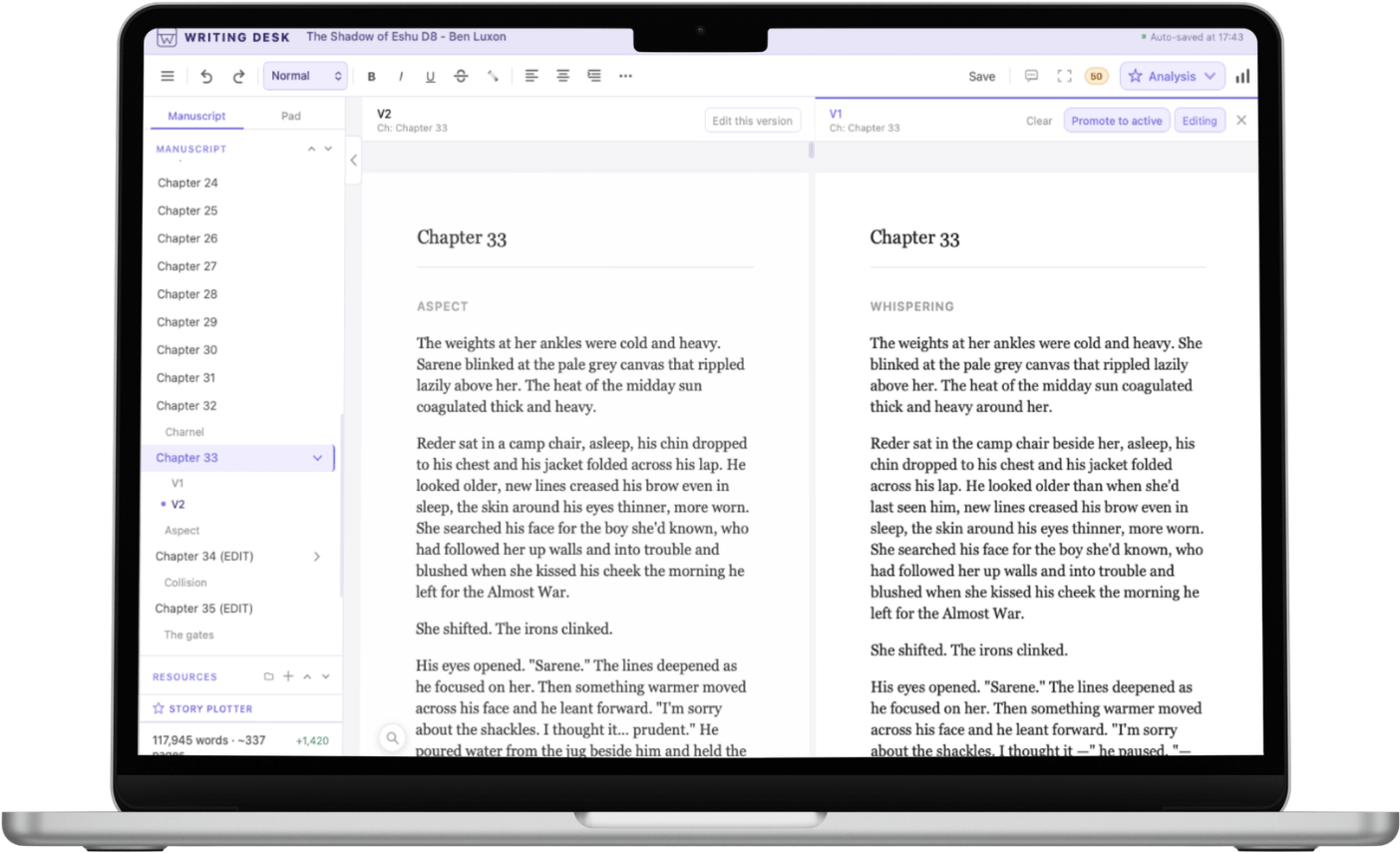
Writing Desk tip: Chapter Variants let you try an alternative version of a chapter without touching your original. Take it as far as you want, then compare side by side. The original never moves.
10. Read your story out loud
Reading aloud is the fastest way to spot errors, find awkward sentences, and hear whether your dialogue sounds like people actually talking.
Your dialogue should sound natural, but don’t make it too real. Skip the filler lines. Cut straight to the good stuff and leave before it gets boring.
Related: How to Write Realistic and Engaging Dialogue
11. Your first draft will not be your last
That first draft is a mammoth effort. You’ll end up with something almost like a book, structured, maybe even coherent, and completely unpublishable.
Think of that first draft as you telling yourself the story. It’ll be messy and inconsistent. You’ll change your mind about plot points and come up with new twists. In one of my novels, I thought I was close to the end and then, in the fifth draft, changed a protagonist’s gender and added a whole new POV character.
Getting that first draft down is progress. You’ve done more than ninety percent of writers ever do. But you’re not done. Not by far.
Put it aside. Work on something else. Then, when you’re ready, come back and start again.
Final Words
If there’s one key takeaway from this list, it’s that you only really figure out how to write a book by writing one.
You can read all the guides, take all the courses, and listen to all the advice, but none of it will teach you what it feels like to wrestle with a story that’s fighting you every step of the way.
So go write. Screw up. Fix it. Do it again. That’s the whole game.
When you finally reach that last page and realise you’ve actually done it, you’ve told a story from start to finish, there’s no feeling quite like it.
And then, of course, you’ll immediately start thinking about the next one.
Related reading:
The writing app built for novelists.
Plot, draft, edit, and format your manuscript in one private, local app for Mac. Free to download. Your writing never leaves your machine.
macOS 13 Ventura or later · No account required