
Most structural frameworks start with calm. Ordinary world, protagonist in their life, slow accumulation of stakes before anything terrible happens. The reader eases in.
The Fichtean Curve dispenses with that entirely. You open in crisis. The reader is thrown into the middle of something already at full tension, and the story builds from there: each crisis harder than the last, until the final confrontation that resolves everything.
It’s not for every story. But when it fits, it fits like nothing else.
Where It Comes From
The Fichtean Curve was fleshed out by John Gardner in The Art of Fiction (1983), where he described it as a narrative structure built on escalating crises rather than a gradual rise from a calm setup. Despite being named for the German philosopher Johann Gottlieb Fichte, the man himself had nothing to do with storytelling; the attribution is Gardner’s, and its basis remains unclear. The structure itself is sound, though, and it describes the shape of a huge amount of successful commercial fiction, particularly in thriller, mystery, and horror.
Writing Desk tip: There’s no dedicated Fichtean Curve template in the Story Plotter, but the freeform Board view works well here: create a card for each crisis, and use the board’s vertical position to represent intensity so the escalation is visible at a glance before you’ve written a word of the actual chapters.
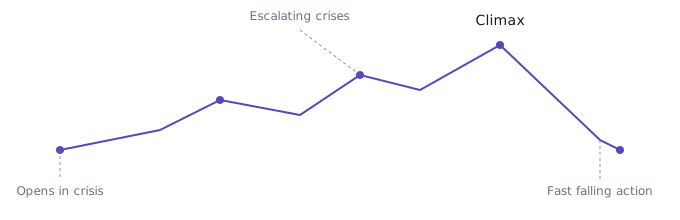
The Shape of It
Rising action, roughly 0 to 80%. The story opens in the middle of the action, in medias res, and the protagonist is immediately in trouble. There’s no exposition-first approach here. Background, character, and world all get revealed through crises rather than setup.
A crisis, in Fichtean terms, is any moment of high tension that forces the protagonist to act, reveal something about themselves, or change direction. It doesn’t have to be physically dramatic; a tense conversation can qualify. What matters is that each crisis builds on the last and raises the stakes. This section makes up the large majority of the novel. The crises accumulate. Each one the protagonist survives makes the next one harder.
Climax, roughly 80 to 90%. The largest crisis, the point every previous scene has been building toward. The protagonist faces the central conflict at its most extreme. Whatever has been chasing, threatening, or eating at them from the inside finally arrives in full.
Falling action, roughly 90 to 100%. Brief. The aftermath of the climax, the resolution of what remains. Faster than in other structures; the Fichtean Curve has been burning at high heat, and the reader doesn’t want a long cooldown. Close the story and close it cleanly.
What It Does Well
Immediate hook. Opening in crisis is one of the most reliable ways to grab a reader. You’re not asking them to wait. You’re throwing them into something on page one.
Sustained tension. The escalating crisis structure means the novel never has an act that’s explicitly about building toward the interesting part. Every part is the interesting part.
Backstory through crisis. Because there’s no setup section, everything the reader learns about the protagonist’s history emerges through how they respond to crises, or what they reveal under pressure. This is showing at its most extreme, and it works beautifully for characters who wouldn’t willingly reveal themselves in calmer circumstances.
Flashback-heavy structures. The Fichtean Curve suits novels that intercut present-day crises with past events particularly well, because the present timeline is already in crisis, so flashbacks can carry exposition without stalling momentum. Everything I Never Told You by Celeste Ng works roughly this way: the dramatic event is revealed on page one, and the novel works backwards through crises to explain it. Gone Girl by Gillian Flynn is a second, more overtly thriller-shaped example: the crisis (a wife’s disappearance) opens the book, and nearly every chapter that follows raises the stakes further, right up to a climax that recontextualises everything the reader thought they understood.
What It Doesn’t Do As Well
Slow-burn character work. If your novel’s emotional core is subtle, a quiet grief, a marriage deteriorating in small increments, the crisis-first structure can feel like the wrong container. Not impossible, but the energy fights the content.
Extended world-building. Fantasy and sci-fi worlds that require significant reader orientation before the stakes make sense don’t always accommodate a cold open into crisis. You can do it, but you have to trust that readers will stay confused long enough to get oriented, and not every story can earn that trust immediately.
The Difference Between Fichtean and Just Starting Fast
One thing the Fichtean Curve is not: a recommendation to start with an action scene and then slow down. That’s a different problem entirely.
What distinguishes the Fichtean Curve from simply starting fast is the sustained escalation. The crises don’t stop after the opening hook; they keep coming, each one building on the last, all the way to the climax. A novel that opens dramatically and then settles into a conventional Act Two isn’t using the Fichtean Curve. It’s using a strong inciting incident and then a different structure entirely.
The commitment to this structure means your entire novel runs at elevated tension. The breathing room happens inside crises; between them is where things get worse.
Is It Right for Your Novel?
Try it if your story opens on a dramatic moment and you find yourself struggling to justify the quieter buildup that precedes it. Try it if you’re writing thriller, mystery, or horror, where sustained tension is the primary contract with the reader. Try it if your protagonist is the kind of person who reveals themselves under pressure better than they do in calm.
Consider something else if your story needs the reader to love the ordinary world before it’s disrupted. The Fichtean Curve denies you that setup, and some stories genuinely need it.
Related reading:

The writing app built for novelists.
Plot, draft, edit, and format your manuscript in one private, local app for Mac. Free to download. Your writing never leaves your machine.
macOS 13 Ventura or later · No account required