Rising action and falling action are the two halves of the shape most novels share. The rising action is everything that builds toward the climax. The falling action is everything that follows it. Get both right and your story has momentum on the way up and a satisfying landing on the way down.
This guide explains both, shows how they fit into the plot diagram, and gives you a process for writing each. It finishes with common mistakes and how to fix them.
What Is a Plot Diagram?
A plot diagram is a chart of how tension rises and falls across a story. It divides the plot into five parts: exposition, rising action, climax, falling action and resolution. You will also see it called a plot pyramid, a plot arc or Freytag’s pyramid, after the nineteenth-century German writer Gustav Freytag, who described the shape while analysing classical and Shakespearean drama.
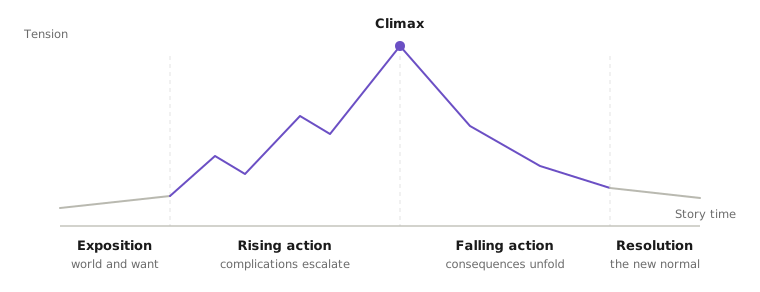
The two parts this guide focuses on are highlighted. Here is what each part of the diagram does:
| Part | What happens | Its job |
|---|---|---|
| Exposition | Your protagonist, their world and what they want | Gives the reader a reason to care |
| Rising action | Complications, obstacles and mounting stakes | Builds tension toward the climax |
| Climax | The decisive confrontation or choice | Settles the central conflict |
| Falling action | The consequences of the climax play out | Releases tension and ties up threads |
| Resolution | The new normal | Shows how your protagonist has changed |
The diagram is a simplification, and few published novels trace it as a smooth curve. Real rising action zigzags, with setbacks and small wins on the way up. Treat the diagram as a map of where tension is heading, not a line your story has to follow exactly. If you want the wider picture of how this shape relates to other frameworks, our story structure guide compares them, and Freytag’s pyramid covers the five-act version in depth.
What Is Rising Action?
Rising action is the stretch of your novel between the setup and the climax. It begins with the inciting incident, which disrupts your protagonist’s ordinary world, and it runs through a chain of complications, obstacles and reversals that raise the stakes until the story can’t go any higher. It is usually the longest part of a novel, and in three-act terms it covers the end of Act One and most of Act Two.
The rising action is where the reader falls in love with your story or loses interest in it. The setup promises something, and the rising action keeps the promise by making things harder for your protagonist in ways that matter.
What Should Rising Action Do?
Good rising action does five jobs at once:
- Raises the stakes. Each stage costs your protagonist more, or threatens something they care about more.
- Creates obstacles. Your protagonist pursues a goal and meets resistance from an antagonist, from circumstance or from their own flaws.
- Develops character. Pressure shows who your protagonist is, and the choices they make under it begin their character arc.
- Delivers information. Backstory, world details and clues arrive when the story needs them, not in one block. Our guide to exposition covers how.
- Builds toward the climax. Every event should make the climax more inevitable, so the reader feels it was coming.
How to Write Rising Action
- Give your protagonist a clear goal. Rising action needs something to push against. When the goal is specific, each obstacle has an obvious meaning for the reader.
- Escalate in stages. Make each obstacle harder or costlier than the last. If the third crisis feels smaller than the first, the story is levelling off instead of rising.
- Link events by cause and effect. Each scene should happen because of the one before it. “And then” produces episodes, while “because of that” produces momentum. Scene and sequel is a practical way to build that chain.
- Mix setbacks with small wins. A steady climb flattens out, so let your protagonist gain ground and lose it. The zigzag in the diagram is deliberate.
- Change direction at the midpoint. A reversal, a revelation or a point of no return near the halfway mark keeps the middle from becoming more of the same. A well-placed plot twist can do this job.
- Weave in your subplots. A subplot that crosses the main plot at a turning point adds pressure and variety to the climb.
- Finish at your protagonist’s lowest point. The rising action should end with a moment where the goal looks out of reach, which sends the story into the climax with its tension at full strength.
If the pace of your middle needs work, see our guides to pacing and how to create tension.
What Is Falling Action?
Falling action is everything that happens after the climax. The central conflict has been settled, and the story now shows what that outcome costs and changes. Tension eases, loose ends are tied off and your characters begin to absorb what has happened. It is the bridge between the climax and the resolution, and in some frameworks the two are treated as one closing movement.
Falling action is the part of the plot diagram writers most often rush or skip. A story that ends the moment the climax lands can feel abrupt, because the reader has been carried to a peak and needs somewhere to come down.
What Should Falling Action Do?
- Show consequences. The climax has a price, and the falling action is where the reader sees it, whether that is a victory with a cost or a defeat with a gain.
- Resolve subplots and open threads. Every question the story raised should be answered or deliberately left open. This is also the moment to pay off the details you planted earlier, which is the idea behind Chekhov’s gun.
- Give characters room to react. After the intensity of the climax, your protagonist and the people around them need a beat to feel what has changed. This is the sequel half of scene and sequel.
- Set up the resolution. The falling action points toward the new normal, so the final pages feel like an arrival.
How Long Should Falling Action Be?
Short, relative to the rising action. As a rule of thumb, the falling action and resolution together take up the last 10 to 15% of a novel, though a story with many threads to close may need more. The test is whether the reader has what they need to feel the story is complete. If it drags, cut scenes that restate an outcome the reader already understands. If it feels abrupt, look for an unanswered question or a character whose fate is unclear.
How to Write Falling Action
- Start close to the climax. Pick up soon after the decisive moment so the reader’s emotional momentum carries into the aftermath.
- Show the cost of the outcome. Let the climax change something visible in your characters’ lives, so the reader sees it has mattered.
- Close threads in order of importance. Resolve the biggest open questions first and the smaller ones after, so the ending narrows toward its final image.
- Let a thread of tension carry through. A last small question, such as whether two characters will reconcile, keeps readers turning pages while the main conflict settles.
- Echo your opening. A callback to an early image, line or setting shows how far your protagonist has come and makes the ending feel designed. Our guide to the character arc explains how that change is built across the whole book.
- Move into the resolution. End the falling action when the story’s central question is answered and the aftermath is clear, then give the reader the final image of the new normal.
If your protagonist is making amends in the aftermath, the beats of a redemption arc often live here.
Rising and Falling Action in Published Novels
The plot diagram is easiest to understand on stories you already know. Here are four, mapped onto its parts. Where one part ends and the next begins is open to interpretation, so treat these as one reasonable reading.
| Novel | Rising action | Climax | Falling action | Resolution |
|---|---|---|---|---|
| Harry Potter and the Philosopher’s Stone (J.K. Rowling, 1997) | Harry learns he is a wizard, starts at Hogwarts and uncovers the secret of the Stone | Harry confronts Quirrell, and Voldemort, in the chamber beneath the school | Harry wakes in the hospital wing and Dumbledore explains what happened | The end-of-year feast and the journey home |
| The Hunger Games (Suzanne Collins, 2008) | Katniss volunteers for her sister, trains and fights to survive the arena | The final fight with Cato and the berries standoff that forces the Capitol’s hand | Recovery after the Games and Haymitch’s warning about the Capitol’s anger | The train ride home to District 12 |
| The Great Gatsby (F. Scott Fitzgerald, 1925) | Gatsby wins Daisy’s attention and the affair builds through the summer | The confrontation at the Plaza Hotel | Myrtle’s death and then Gatsby’s own | Gatsby’s funeral and Nick’s departure |
| The Return of the King (J.R.R. Tolkien, 1955) | The war for Gondor and the journey into Mordor | The Ring is destroyed at Mount Doom | The coronation, the return home and the Scouring of the Shire | The Grey Havens |
Three things stand out when you lay them side by side.
The climax is a choice or a confrontation, never just an event. Harry has to face the man who has been hunting the Stone, and Katniss has to decide how far to push the Capitol. The protagonist’s action settles the conflict.
Falling action varies in length and weight. In Harry Potter it is a single conversation. In The Return of the King it is a long sequence in its own right, because Tolkien has a whole story to finish after the Ring is gone and the Scouring of the Shire gives the returning hobbits a final test. The length of your falling action depends on how much the climax leaves unsettled.
Falling action can carry its own tension. In The Great Gatsby, the two deaths after the Plaza scene keep the reader’s attention while the aftermath unfolds. In The Hunger Games, Haymitch’s warning points forward to trouble the book hasn’t resolved. A good falling action lowers the tension without removing it.
Common Rising and Falling Action Mistakes
The plot diagram works as a diagnostic tool. When a draft isn’t working, find the part of the curve where it goes wrong.
| What you notice | Likely cause | What to try |
|---|---|---|
| The middle feels flat | Obstacles don’t escalate, or the stakes stay the same | Make each crisis costlier than the last and add a midpoint reversal |
| Events feel disconnected | Scenes follow each other without cause and effect | Link scenes with “because of that” and cut any that change nothing |
| The climax feels sudden | The rising action never pointed toward it | Plant the threat and the protagonist’s need early, then raise the stakes toward it |
| The climax feels easy | There is no low point before it | Add an all-is-lost moment and make the protagonist’s choice decide the outcome |
| The ending feels abrupt | Falling action is missing or too short | Show consequences and close open threads before the final image |
| The ending drags | Falling action restates what the reader knows | Cut scenes that repeat an outcome and keep the ones that reveal a cost |
| A subplot is left hanging | It never joined the main plot | Resolve it in the falling action, or connect it to a turning point in the rising action |
| The protagonist hasn’t changed | The arc was not planned across the curve | Decide what they believe at the start and let the climax test it |
Work top to bottom, since a weak rising action causes most of the problems below it. For a wider checklist of structural fixes, our story structure guide has a longer diagnostic table, and revising your first draft shows where structural checks fit in the revision process.
How Rising and Falling Action Fit Other Story Structures
The plot diagram describes one shape, and most major frameworks contain it under different names. Once you can spot rising and falling action, you can move between them easily.
| Framework | Where the rising action sits | Where the falling action sits |
|---|---|---|
| Three-act structure | End of Act One through most of Act Two | The end of Act Three, after the climax |
| Freytag’s pyramid | The second of five parts | The fourth of five parts |
| Seven-point structure | First plot turn through the second plot turn, with pinch points | The resolution |
| Save the Cat | Catalyst through the Dark Night of the Soul | The Final Image |
| The Hero’s Journey | Crossing the Threshold through the Ordeal and the Road Back | The Return with the Elixir |
| The Fichtean curve | Almost the entire story, built from successive crises | A short stretch after the climax |
The classroom plot diagram is a simplified version of Freytag’s pyramid. In Freytag’s original, the climax sits in the middle of the structure, so the falling action takes up about as much of the story as the rising action. The diagram most writers use today places the climax late, which gives a long climb and a short descent.
Kishōtenketsu is the exception. It is built on a twist rather than on conflict, so it has no rising action in the usual sense. If your story doesn’t escalate toward a confrontation, the plot diagram may not be the right map. The four-act structure is a useful alternative when you want to plan the long climb in two parts instead of one.
Writing Desk tip: The Story Plotter includes eleven structure templates, among them Three-Act, Hero’s Journey and Save the Cat, plus genre arcs for romance, mystery, thriller, fantasy, horror and young adult. Pick one and the major beats are placed for you, then use the board view to check that your rising action escalates, your climax has weight behind it and your falling action has the scenes it needs to close your threads.
Frequently asked questions
What is rising action in a story?
Rising action is the sequence of events between the setup and the climax. It begins with the inciting incident and builds through complications, obstacles and rising stakes until the story reaches its decisive moment.
What is falling action in a story?
Falling action is everything that happens after the climax. It shows the consequences of the central conflict, releases tension and closes open threads on the way to the resolution.
What are the five parts of a plot diagram?
The five parts are exposition, rising action, climax, falling action and resolution. Together they show how tension builds to a peak and then falls away.
What is the difference between rising action and falling action?
Rising action builds tension toward the climax, and falling action releases it afterwards. The rising action asks whether the protagonist will succeed, and the falling action shows what the outcome means.
Is the climax part of the rising action or the falling action?
Neither. The climax is the turning point between them, the moment where the central conflict is decided. The rising action leads into it and the falling action follows from it.
How long should rising action be?
It is usually the longest part of a novel, because it carries the escalating conflict. In three-act terms it covers the end of Act One and most of Act Two.
Does every story need falling action?
Most conflict-driven stories benefit from one, because readers need to see the consequences of the climax. In a short story it might be a paragraph, and in a novel with many threads it may take several chapters.
What is a plot diagram used for?
A plot diagram helps you plan a story’s shape and diagnose a draft. Plot your scenes against it and you can see where tension rises, where it stalls and whether the ending has the scenes it needs.
Related reading:

The writing app built for novelists.
Plot, draft, edit, and format your manuscript in one private, local app for Mac. Free to download. Nothing leaves your Mac unless you choose to sync it.
macOS 13 Ventura or later · No account required