
I resisted the Hero’s Journey for years. It felt like a formula, the kind of thing that turns living stories into paint-by-numbers. I wanted to believe my novels were more original than that.
Then I started reading them against Campbell’s framework. Every single one mapped roughly onto it. The ones that worked most cleanly were the ones that felt most alive. The ones that drifted away from it in Act Two were the ones that stalled.
I’m not saying every novel should follow the Hero’s Journey, or that you should start planning with it in mind and force your story to fit. What I’m saying is: understanding it will help you write stronger novels, even if you never consciously apply it. Because it’s not a formula, it’s a description of how transformation works. And transformation is what fiction is about.
What Is the Hero’s Journey?
Joseph Campbell identified a pattern that recurs across mythology, folklore, and religion from cultures all over the world: a hero leaves their known world, crosses into an unfamiliar one, faces an ordeal that tests and changes them, and returns transformed.
He called it the monomyth. Christopher Vogler later adapted it for Hollywood screenwriters, and it’s been the backbone of commercial fiction and film ever since. Star Wars. The Lord of the Rings. Harry Potter. The Hunger Games. All of them follow the shape.
This doesn’t make those stories formulaic. It makes them tap into something universal about how humans understand change.
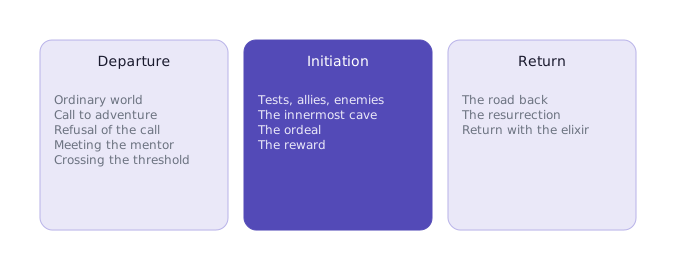
The Twelve Stages, What Each Actually Means
I’m going to give you the stages, but I want to be honest about how I actually use them: I think about the structure in three big movements, Departure, Initiation, Return, and use the individual stages as diagnostic tools when something isn’t working, not as boxes to check during planning.
The Ordinary World
Before the adventure starts, we see the hero in their everyday life. This stage does two things: establishes who they are before the journey changes them, and gives us something to measure their transformation against.
The mistake writers make here: spending too long in the Ordinary World. Two or three scenes. Enough to care about who your protagonist is and feel the contrast when their life is disrupted. No more.
The Call to Adventure
Something happens that pulls the hero out of their ordinary life and toward the adventure. It might be a mission, a discovery, a loss, an invitation. The world changes and your protagonist can no longer ignore it.
This is your inciting incident. It should arrive early, by the 10–15% mark. Everything before it is setup. Everything after it is story.
Refusal of the Call
The hero hesitates. This is the “yes, but, “ moment. They see the cost of answering the call and pull back.
I used to skip this stage in early drafts and my protagonists came across as passive. The Refusal isn’t cowardice, it’s humanity. It shows us what your protagonist has to lose, which is the same thing that makes their eventual commitment meaningful.
Meeting the Mentor
A figure who gives the hero what they need to cross the threshold, knowledge, equipment, confidence, a push. The mentor doesn’t make the journey for them; they prepare the hero to make it themselves.
Gandalf. Dumbledore. Morpheus. The pattern is so prevalent because it’s doing real structural work: it signals that the hero is about to enter a world they don’t yet understand, and gives the reader confidence that they’re equipped to face it.
Crossing the Threshold
The hero commits. They enter the new world, and the story proper begins. There’s no going back from this moment.
In three-act terms, this is your end of Act One.
Tests, Allies, and Enemies
The hero navigates the new world. They make allies, encounter enemies, and begin to understand the rules of the place they’ve entered. This is the first half of Act Two, your protagonist finding their footing.
The mistake here: making the tests too easy. Your hero should win some and lose some. They should be wrong about who to trust. The point of this stage is that the new world is harder than they expected.
The Innermost Cave
The hero approaches the central ordeal, the most dangerous place, the most feared confrontation, the deepest challenge. This is often the midpoint of your novel: the moment before everything gets worse.
The Ordeal
The hero faces their greatest challenge and appears to fail, or loses something significant. Death and rebirth, literal or metaphorical. This is your all-is-lost moment.
The Ordeal is where transformation happens. The hero who survives it is not the same person who entered the cave. If your protagonist emerges from the climax essentially unchanged, this stage hasn’t done its job.
The Reward
After the Ordeal, the hero gains something, knowledge, a physical object, a truth about themselves or the world. This is the pivot from Act Two to Act Three: your protagonist now has what they need to face the final conflict. The question is whether they can use it.
The Road Back
The hero begins the return to the ordinary world, but they’re not done yet. A final obstacle, a chase, a complication. The villain reasserts. The cost of the journey becomes clear.
The Resurrection
The hero faces a final test, one last confrontation that requires them to apply everything they’ve learned. This is your climax. The transformation has to be demonstrated here, not just claimed.
The difference between a strong climax and a weak one: in a strong climax, your protagonist does something they couldn’t have done in chapter one. The entire novel exists to get them to this moment.
Return with the Elixir
The hero returns home changed, and brings something back with them. Knowledge, healing, a solution. The ordinary world is different for their having made the journey.
Your ending. It doesn’t have to be happy. But it has to be true to who your protagonist has become.
Adapting It to Your Genre
The Hero’s Journey maps naturally onto fantasy and adventure. For other genres, the “journey” is more internal.
In literary fiction, the Ordinary World and the Ordinary World-after are emotional states rather than physical places. The Ordeal is a confrontation with truth rather than a villain.
In romance, the journey is toward connection. The Threshold is the moment the protagonists can no longer avoid their feelings. The Ordeal is the dark moment when it looks like the relationship can’t survive. The Return is the resolution of that conflict.
In thriller and crime, the Ordinary World is disrupted by a crime or threat. The journey is the investigation. The Ordeal is the moment the protagonist’s life is genuinely at risk. The Resurrection is the confrontation with the antagonist.
The stages adapt. The underlying logic, departure, transformation, return, doesn’t change.
Where Writers Go Wrong
Skipping the Refusal. Protagonists who leap at every call feel thin. Let them hesitate.
A mentor who does too much. If Gandalf fights the battle for Frodo, there’s no story. The mentor equips; the hero acts.
An Ordeal with no cost. Transformation requires loss. If your protagonist survives the dark moment without losing anything, materially, emotionally, in terms of who they believed they were, it doesn’t count as an ordeal.
A Resurrection that could have happened in chapter one. The climax has to demonstrate change. Whatever your hero does here must be something they were incapable of at the start.
Writing Desk tip: The Story Plotter includes a Hero’s Journey template, all twelve stages mapped as cards on the board, which you fill in with your story’s specific events. Switch to doc view to write the outline in prose form instead; both stay in sync.
Related reading:

The writing app built for novelists.
Plot, draft, edit, and format your manuscript in one private, local app for Mac. Free to download. Your writing never leaves your machine.
macOS 13 Ventura or later · No account required