
A character arc is the internal change a character goes through over the course of a story: the difference between who they are at the start and who they are by the end, and the specific process that gets them from one to the other.
It’s tempting to assume this happens automatically. Put a character through enough plot and they’ll come out the other side different somehow. That’s true in the loosest sense, and it’s also not a plan. The difference between a story with a strong character arc and one without usually isn’t how much happens to the character. It’s whether the writer decided, before drafting, exactly what belief the character holds at the start, what would have to happen to break that belief, and what they’d believe instead by the end. A character arc built on intention shows up on the page. One left to accumulate on its own usually doesn’t, no matter how eventful the plot is.
Character Arc vs. Plot, and vs. Profile
Plot and character arc are related but distinct. Plot is the sequence of events. Character arc is what those events do internally to the person experiencing them. Two novels can share nearly the same plot (a heist gone wrong, a divorce, a war) and produce entirely different arcs, because the arc lives in interpretation and change, not in the events themselves.
A character profile captures who a character is: their fears, history, contradictions, the fixed material of them. A character arc is what moves through that material over the course of the story. The profile tells you where a character starts. The arc is the plan for where the story takes them, and why.
Writing Desk tip: Store your character’s core belief and arc type in their Character Notes inside the Resource Hub. The AI Editor’s developmental review can reference it directly, flagging chapters where a character’s choices no longer track with the arc you’ve defined for them.
The Lie Your Character Believes
Most useful character arc frameworks start in the same place: your character enters the story believing something false about themselves or the world, and the story’s job is to test that belief until it either breaks or hardens.
This false belief is sometimes called the character’s “lie,” sometimes their “wound,” sometimes their “misbelief.” The terminology varies, the mechanism doesn’t. Somewhere in your character’s past is an experience that taught them something untrue: I’m only valuable if I’m in control. Love always leaves. Trusting people gets you hurt. They’ve built a working life around that belief. It has protected them, or at least felt like it has.
Two other terms sit alongside the lie:
Want is what your character consciously believes they’re after: the external goal. Solve the case, win the war, get the promotion.
Need is what would actually make them whole, whether they know it or not. Usually the opposite of the lie.
The engine of most satisfying arcs is the gap between want and need. Your character spends the story chasing the want. The plot’s job is to force the need into view, typically by making the want increasingly expensive to keep pursuing while the lie is still believed.
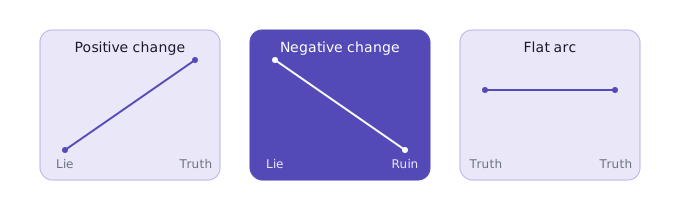
The Three Types of Character Arc
Positive Change Arc
The character begins in the grip of the lie, is tested by the plot’s escalating conflict, and by the end has replaced the lie with something closer to the truth. This is the most common arc for protagonists, especially in commercial fiction. It’s the shape of most redemption stories, most coming-of-age stories, most hero’s-journey stories.
Example: Ebenezer Scrooge in A Christmas Carol begins believing that wealth and isolation equal safety. Three ghostly visitations force him to confront the cost of that belief, and he ends the story having exchanged it for generosity and connection. It’s such a clean example of the shape that “he’s basically Scrooge” has become shorthand for the arc itself.
Negative Change Arc
The character begins in the grip of the lie, or a smaller, more forgivable version of it, and instead of overcoming it, they’re consumed by it. The plot doesn’t test the lie into breaking; it tests the lie into hardening, or gives the character every excuse to keep believing it until the belief destroys them.
Negative arcs are the shape of most tragedies, and of most well-written villain and antihero backstories.
Example: Walter White in Breaking Bad begins with a lie that’s almost sympathetic: that providing for his family justifies whatever he has to do to achieve it. Every season gives him a genuine off-ramp. He never takes one. By the end, the lie hasn’t just hardened, it’s consumed the man who once used it as a justification.
Flat Arc
The character enters the story already believing the truth, and instead of being changed by the plot, they change the world around them, or the other characters, by refusing to abandon what they already know. This takes real craft to write well, because the tension has to come from external pressure to abandon the truth rather than from the character’s own internal contradiction.
Flat arcs are common for series leads who need to stay essentially stable across many books, for stories about integrity under pressure, and for characters who function as a fixed point that other characters orbit and are changed by.
Example: Atticus Finch in To Kill a Mockingbird doesn’t discover that racial injustice is wrong over the course of the novel. He knows it from page one, and the story is about what it costs him to act on that knowledge in a town that doesn’t share it. The arc belongs to Scout, watching him.
A quick way to identify which type you’re building: does your protagonist end the story believing something they didn’t believe at the start (a change arc, positive or negative depending on direction), or does the story end with the world having to reckon with a belief they held the whole way through (a flat arc)?
Character Arc by Genre
Genre doesn’t lock you into an arc type, but there are strong conventions worth knowing before you decide to break them.
| Genre | Typical arc | Why |
|---|---|---|
| Romance | Positive, often for both leads | The genre’s core promise is two people becoming capable of love by overcoming what was stopping them |
| Tragedy | Negative | The genre is defined by the fall, not the possibility of avoiding it |
| Thriller / action | Flat protagonist, varied antagonist | A competent hero who stays competent while the plot escalates around them is often the point |
| Mystery | Flat detective, negative culprit | The detective is usually a stable lens; the arc belongs to whoever they’re investigating |
| Literary fiction | Any, often ambiguous | The genre’s interest is frequently in complicating the clean version of any of these |
| Fantasy / coming-of-age | Positive | Closely tied to the Hero’s Journey, which is arc-shaped by design |
How Character Arc Connects to Structure
Character arc and plot structure aren’t separate planning tasks. The strongest frameworks are built to force them together. In three-act structure, the midpoint is usually where a character gets their first real glimpse of the truth, and the all-is-lost moment is usually where the cost of the lie becomes undeniable. Save the Cat makes this explicit: the Dark Night of the Soul beat exists specifically to force the choice between lie and truth right before the climax.
If you’re using one of the story structure frameworks to plan your novel, the fastest way to strengthen both is to map the arc stages onto the same beats, not as two separate documents but as one. What the plot is doing to your character and what your character believes at that moment should always be answerable from the same page.
Common Character Arc Mistakes
The change happens in one scene near the end. If the transformation is delivered in a single speech or revelation in the final act, it reads as unearned no matter how well the scene is written. Change needs to accumulate: small tests, small cracks in the lie, well before the climax forces the final choice.
The character already knows their own lie. Part of what makes a lie a lie is that the character can’t see it clearly, or has convinced themselves it’s a strength rather than a wound. A character who narrates their own flaw accurately from chapter one has nothing left to discover.
The arc contradicts the plot’s demands. If the plot requires a character to make a brave choice in Act Three, but everything about their arc has been trending toward isolation and self-protection right up until that point, the choice reads as the author overriding the character rather than the character earning it.
Mistaking a static character for a flat arc. A static character who simply doesn’t grow because the story never asks anything of them is a missed opportunity, not a flat arc. A true flat arc requires real pressure to abandon the truth. Without that pressure, “unchanging” just reads as underused.
Final Words
Not every character in your novel needs a fully mapped arc. Background and supporting characters can exist perfectly well as static presences. But your protagonist, and usually your antagonist, need you to know three things before you write a single scene: what they want, what they need, and the lie standing between the two. The plot, the structure, the midpoint, the climax: all of it is the machinery that tests that lie until it breaks, hardens, or gets proven right.
Get that part right and the ending stops being something you have to engineer. It becomes the only place the story could have gone.
Related reading:

The writing app built for novelists.
Plot, draft, edit, and format your manuscript in one private, local app for Mac. Free to download. Your writing never leaves your machine.
macOS 13 Ventura or later · No account required