
I first came across Save the Cat as a screenwriting tool and assumed it wouldn’t translate to fiction. Too prescriptive. Too page-count specific. Too tied to the two-hour structure of film.
Then I tried using it on a novel that wasn’t working and discovered two things: first, it diagnosed the problems faster than anything else I’d tried. Second, the beats it named, especially Fun and Games, All Is Lost, and Dark Night of the Soul, gave me language for structural concepts I’d been circling around but couldn’t articulate.
You don’t have to follow it religiously. But knowing it is worth your time.
What Is It?
Blake Snyder was a Hollywood screenwriter who published Save the Cat! in 2005. It became one of the most widely used structural frameworks in Hollywood, and the official Blake Snyder Beat Sheet is still maintained by the team behind the original books. Novelists and writing teachers eventually adapted it for fiction, because the underlying logic transfers almost exactly.
The beat sheet gives you fifteen named story beats with approximate word count or page targets. For a 90,000-word novel, the targets below assume that length, adjust proportionally for your own.
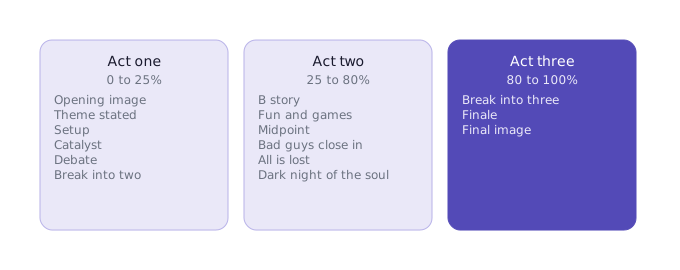
The Fifteen Beats
1. Opening Image (~0–1%) Your novel’s first impression. The world before the story begins, ideally an image or moment that captures who your protagonist is and what’s about to change. The Opening Image should contrast with the Final Image, together they show transformation.
2. Theme Stated (~5%) Someone, not necessarily the protagonist, says something that contains the theme of your novel. Usually indirect. Often the protagonist doesn’t fully understand it yet. Look for it in your drafts rather than planting it consciously: it’s often already there.
3. Setup (~1–10%) We meet the protagonist, understand their world, and see what’s broken in their life, the thing they need (emotionally) even if they don’t know it yet. Plant the seeds of what will pay off later. Every subplot, every secondary character, every recurring image that matters should be introduced here.
4. Catalyst (~10%) The inciting incident. The event that disrupts the ordinary world and kicks the story into motion. Something happens that the protagonist can’t ignore. It doesn’t have to be dramatic on the surface, but it has to be the moment the story’s engine starts.
5. Debate (~10–20%) The protagonist hesitates. Should they go on the adventure, take the case, make the move? This is the Refusal of the Call from the Hero’s Journey. It earns the eventual commitment by showing us what they have to lose.
6. Break Into Two (~20–25%) The protagonist makes a decision and crosses the threshold. They enter the new world of the story. This is your Act One ending, the point of no return. Before this beat, they were reacting. After it, they’re acting.
7. B Story (~25%) A secondary story thread begins, often a relationship that carries the theme. In a thriller, this might be a mentorship or a romance. In literary fiction, it might be a family dynamic. The B Story provides emotional counterpoint to the A Story’s plot mechanics.
8. Fun and Games (~20–50%) The most commercially important section of your novel. This is the “promise of the premise”, the reason your reader picked up this book. If it’s a heist novel, this is where the heist is being planned and enjoyed. If it’s a romance, this is the falling-in-love section. The A Story’s conflict is building, but your protagonist is still relatively in control.
This section is called Fun and Games because it should be, these are the scenes your reader came for. Don’t rush to the dark stuff.
9. Midpoint (~50%) A shift. Either a false victory (things look great, but the real problem is closing in) or a false defeat (things fall apart in a way that clarifies what the protagonist actually needs to do). Either way, the protagonist moves from reactive to proactive, or from safe to vulnerable.
10. Bad Guys Close In (~50–75%) Everything the protagonist built in Fun and Games starts to come apart. External antagonism intensifies. Internal doubts resurface. Allies are tested. The B Story and A Story start to converge. The stakes keep rising.
11. All Is Lost (~75%) The lowest point. Everything appears to be over. The protagonist has failed, or lost someone, or made an irreversible mistake. Often there’s a “whiff of death” here, literal or symbolic. Someone dies. Something that can’t be replaced is destroyed. A relationship breaks.
This beat needs to genuinely hurt. A mild setback at this point breaks the reader’s trust in your climax.
12. Dark Night of the Soul (~75–80%) The protagonist sits in the all-is-lost moment and doesn’t know how to go on. This is where they have to reckon with who they are and what they want, and find something inside themselves that they didn’t know was there.
The answer can’t come from outside. It has to come from within. This is what makes the climax feel earned.
13. Break Into Three (~80%) A synthesis. The A Story and B Story come together and the protagonist has a new understanding, of themselves, of the problem, of what they need to do. They move into Act Three with renewed purpose.
14. Finale (~80–99%) The climax. Your protagonist acts, directly, decisively, using everything they’ve learned, to resolve the central conflict. Not in the way they thought at the beginning, but in the way their arc has prepared them for.
Snyder breaks the Finale into five “towers” (gathering the team, executing the plan, the high tower surprise, dig deep down, and the execution of the new plan). For novel purposes: the key is that the climax should have at least one reversal and require the protagonist to dig deeper than they thought possible.
15. Final Image (~99–100%) Mirror of the Opening Image. The world after the story. The protagonist transformed. If your Opening Image and Final Image don’t stand in meaningful contrast, your protagonist probably hasn’t changed enough.
The Beat Sheet as Diagnostic Tool
Where Save the Cat earns its place on my desk isn’t in planning, it’s in diagnosing problems in existing drafts.
When Act Two sags, it’s usually because Fun and Games isn’t delivering the story’s promise, or because Bad Guys Close In isn’t actually getting worse. When the climax doesn’t land, it’s often because the Dark Night of the Soul was too thin, the protagonist didn’t have to earn the solution from somewhere deep enough.
Name the beat that’s failing and you know where to look.
Writing Desk tip: The Story Plotter includes a Save the Cat template, all fifteen beats placed on the board for you to build from. Adjust the scene cards within each beat, or switch to doc view to write the outline in prose instead.
Related reading:

The writing app built for novelists.
Plot, draft, edit, and format your manuscript in one private, local app for Mac. Free to download. Your writing never leaves your machine.
macOS 13 Ventura or later · No account required