
Most writers learn the three-act structure first. I did too. And for a long time I found the second act, the long middle that spans roughly half the book, the hardest section to sustain. It would start well and then somewhere around the 40% mark I’d lose the thread. The escalation would flatten out. The protagonist would feel like they were treading water.
The four-act structure solved that problem for me, because it names what was actually wrong: I didn’t have a true midpoint. I had a vague sense that things should get harder in the middle, but no structural anchor to hang it on. Splitting Act Two into two distinct halves, each with its own momentum, gave me that anchor.
How It Differs from Three Acts
In the three-act structure, Act Two runs from roughly the 25% to the 75% mark of your novel. It’s a long stretch, approximately half the book, with one major structural beat in the middle (the midpoint) and one at the end (the all-is-lost moment).
The four-act structure makes that midpoint a genuine act break. What was Act Two becomes Act Two and Act Three, each with its own shape, momentum, and function. The all-is-lost moment becomes the Act Three to Act Four transition.
The result is four acts of roughly equal length, each doing a distinct job.
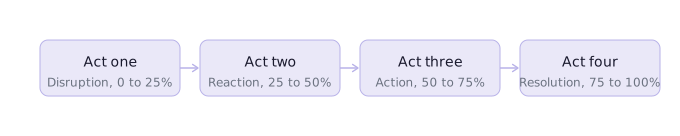
Act One: Disruption (~0–25%)
Same function as in three-act structure. Establish your protagonist in their ordinary world, introduce the central conflict, and end with the first plot point, the moment that locks them into the story.
The first plot point should arrive by the 25% mark. Before it, your protagonist has a choice. After it, they’re committed.
Act Two: Reaction (~25–50%)
This is where the four-act structure earns its keep.
In Act Two, your protagonist is responding to the new situation the first plot point threw them into. They’re trying to understand the rules of this new conflict, finding allies, making mistakes, misjudging the situation. They’re reactive, things are happening to them and around them, and they’re scrambling to keep up.
The tone of Act Two is disorientation. Your protagonist doesn’t yet know how to win. They may not even know what winning looks like.
Act Two ends with the midpoint, a significant development that shifts the protagonist from reactive to proactive. New information, a decision they can’t take back, a moment of clarity about what they’re actually up against. After the midpoint, the story’s direction changes.
Act Three: Action (~50–75%)
Your protagonist is now driving events rather than reacting to them. They have a plan, maybe not a good one, but a plan. They’re pursuing it actively.
This is where things should get significantly worse. The plan fails, or works in ways they didn’t anticipate, or costs more than they expected. The stakes escalate. The antagonist pushes back harder. The complications narrow their options down to one painful choice.
Act Three ends with the all-is-lost moment, the second major plot point. Your protagonist hits their lowest point. The goal appears out of reach. What they’ve been working toward seems impossible. This is the darkest moment of the novel, and it has to be genuinely dark, not just a setback, but a moment where it looks like they cannot possibly succeed.
Act Four: Resolution (~75–100%)
Your protagonist digs out from the all-is-lost moment and pushes toward the climax.
The climax is the central confrontation, the moment they face the core conflict directly and resolve it, through their own action, grown from who they’ve become across the story. What they do here should be something they were incapable of in chapter one.
The resolution ties off what remains: who they are now, what they’ve lost or gained, what the world looks like on the other side.
The Structure at a Glance
| Act | Range | Ends with |
|---|---|---|
| Act One: Disruption | 0–25% | First plot point |
| Act Two: Reaction | 25–50% | Midpoint (reactive → proactive) |
| Act Three: Action | 50–75% | All-is-lost moment |
| Act Four: Resolution | 75–100% | Climax and resolution |
When to Use It
The four-act structure suits novelists who struggle with the long middle, specifically, writers who find that their second act loses direction or momentum around the halfway mark.
It’s also naturally suited to stories with two clear phases of conflict: an initial phase where the protagonist is figuring out what they’re dealing with, and a second phase where they’re actively fighting it. Crime fiction often has this shape. So does a lot of thriller and fantasy.
It maps cleanly onto the Save the Cat beat sheet (which is also essentially four-act in structure, despite being described as three). If you’ve used Save the Cat and found it useful, you were already working in four acts.
Writing Desk tip: The Story Plotter doesn’t have a dedicated Four-Act template, but the Three-Act template’s Act Two spans the same territory. Add a card at the midpoint marking your reaction-to-action shift and you’ve effectively split it into four, without losing the built-in beat placement.
Related reading:

The writing app built for novelists.
Plot, draft, edit, and format your manuscript in one private, local app for Mac. Free to download. Your writing never leaves your machine.
macOS 13 Ventura or later · No account required