
The three-act structure gets a bad reputation in certain writing circles. Too simple, too prescriptive, too Hollywood. I’ve heard novelists dismiss it as a formula for people who can’t think for themselves.
Those same novelists often have the same problem I had before I learned it: a first act that drags, a second act that sags, and a third act that doesn’t quite earn what it’s asking of the reader. The three-act structure doesn’t cause those problems. It’s what you use to diagnose and fix them.
What It Is
Three acts. Setup, confrontation, resolution. Beginning, middle, end.
That’s it, at the level of description. The reason it’s more useful than it first sounds is what lives inside each act: specific structural beats that have to do specific jobs, without which the act doesn’t work. The three-act structure isn’t the acts themselves. It’s the transitions between them, and the mechanics of what those transitions require.
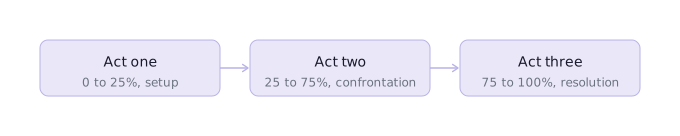
Act One: Setup
Act One runs roughly from the opening to the 25% mark of your novel.
Its job is to establish three things: who your protagonist is, what their world looks like before the story begins, and the central problem that will drive the rest of the book.
The act ends with the first plot point, the event that locks your protagonist into the story’s central conflict. There’s no going back from this moment. Before it, they could have chosen to walk away. After it, they can’t.
The first plot point isn’t always dramatic on the surface. It can be a decision, a discovery, an arrival, an accusation. What matters is that it changes the direction of your protagonist’s life in a way that can’t be undone.
The inciting incident, the event that first disrupts your protagonist’s ordinary world, happens earlier, usually around the 10% mark. This is what gets the story’s engine running. The first plot point is when the engine commits to a destination.
Common Act One mistake: Spending too long in the ordinary world. Readers need enough of it to care about what’s being disrupted, not so much that they’re waiting for the story to start.
Act Two: Confrontation
Act Two is the longest section, roughly 25% to 75% of your novel, and the hardest to write. It’s where most novels stall, and where most structural problems live.
The job of Act Two is escalation. Your protagonist is pursuing their goal, and the obstacles keep getting worse. Each complication raises the stakes, narrows their options, or forces a decision that costs them something.
Two structural beats hold Act Two together.
The midpoint, around the 50% mark, is a shift in the direction of your story. New information, a reversal, a moment where the protagonist moves from reactive to proactive (or vice versa). Without a midpoint that genuinely changes the story’s direction, Act Two becomes a straight line, and straight lines lose readers.
The second plot point, around the 75% mark, is your protagonist’s lowest moment. The all-is-lost beat. It looks, for a moment, like they cannot possibly succeed. Everything they’ve been working toward appears out of reach. This is what makes Act Three feel earned.
Common Act Two mistake: Filling the middle with events rather than escalation. Things happening isn’t the same as things getting worse. In a working Act Two, every complication should narrow the protagonist’s options or deepen the cost of what they’re trying to do.
Act Three: Resolution
Act Three runs from roughly the 75% mark to the end. Its job is to resolve the central conflict your novel has been building toward, through your protagonist’s direct action.
The climax is where your protagonist confronts the central problem and resolves it. What they do in this moment should be something they couldn’t have done in chapter one. If the climax could have happened at the beginning of the book, Act Two hasn’t done its job.
The resolution, the final pages, shows us who your protagonist is on the other side of that confrontation. It doesn’t have to be happy. It has to be true to everything that came before it.
Common Act Three mistake: A climax that happens to the protagonist rather than because of them. Rescue, coincidence, external intervention. If the solution arrives from outside rather than from within your protagonist, the emotional payoff collapses.
The Beats in Summary
| Beat | Approximate position | Function |
|---|---|---|
| Inciting incident | ~10% | Disrupts the ordinary world |
| First plot point | ~25% | Locks protagonist into the conflict |
| Midpoint | ~50% | Shifts the direction of Act Two |
| Second plot point / all-is-lost | ~75% | Protagonist’s lowest moment |
| Climax | ~90% | Central conflict resolved |
| Resolution | Final pages | Who the protagonist is now |
Why It Works Across Every Genre
The three-act structure isn’t a Hollywood invention. It’s a description of how readers experience satisfaction in a story, the same pattern that appears in Greek tragedy, in fairy tales, in the structure of jokes. Aristotle’s description of drama in the Poetics is essentially a three-act argument.
What changes across genres is texture, not shape. A romance has three acts. A psychological thriller has three acts. A quiet literary novel about grief has three acts. What’s happening inside each act looks completely different depending on the story. The architecture is the same.
Using It as a Diagnostic Tool
The most practical use of the three-act structure isn’t planning, it’s revision.
When something isn’t working, the first question is: which act is the problem in? Is Act One too slow to reach the first plot point? Does Act Two have a midpoint that genuinely shifts direction? Does the climax grow from the protagonist’s arc or from external circumstances?
Most problems in a draft are structural problems wearing prose-level disguises. Learning to see the structure lets you find them.
Writing Desk tip: The Story Plotter includes a Three-Act Structure template, the six major beats placed for you on the board, with room to build your scene list around them. Switch to doc view to write the outline in prose if you prefer; both live in the same plan.
Related reading:

The writing app built for novelists.
Plot, draft, edit, and format your manuscript in one private, local app for Mac. Free to download. Your writing never leaves your machine.
macOS 13 Ventura or later · No account required