
A story structure with no conflict. No antagonist forcing the protagonist’s hand. No problem to be solved. That’s not quite right, but there’s enough truth in it to be genuinely unsettling for anyone trained on Western three-act story logic. Kishotenketsu doesn’t build through conflict escalation. It builds through revelation, and once you understand what it’s doing, you start seeing it in places you didn’t expect.
What It Is
Kishotenketsu (起承転結) is a classical Chinese and Japanese narrative structure with roots in poetry, later applied to drama, manga, and prose fiction. The four characters in the name roughly translate as:
- Ki (起): introduction, beginning
- Sho (承): development, continuation
- Ten (転): twist, turn, surprise
- Ketsu (結): reconciliation, conclusion
The structure is four acts, but the logic is completely different from Western four-act structure. What drives the story isn’t a conflict that escalates toward resolution; it’s a twist in the third act that recontextualises everything before it, followed by a reconciliation that makes sense of the whole.
Writing Desk tip: Because kishotenketsu doesn’t map onto conflict-escalation beats, it’s a difficult structure to track with a conventional beat sheet. The Story Plotter’s Board view works well here: use one column per act (Ki, Sho, Ten, Ketsu) and treat the Ten column as the pivot the other three build toward and resolve from.
The Four Acts
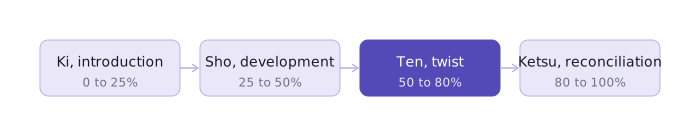
Ki, introduction, roughly 0 to 25%. Introduce the world, the protagonist, and the situation. Establish the elements of the story clearly enough that the Ten will land with full force when it arrives. There’s no inciting incident in the Western sense here. You’re not disrupting an ordinary world; you’re setting up the premises that the third act will subvert. The introduction should be vivid and specific, because the twist’s power depends on the reader having clear expectations to overturn.
Sho, development, roughly 25 to 50%. Develop what the introduction established. Follow the logic of the opening into deeper territory: the same characters, the same world, the same themes, but enriched. No conflict has to be introduced. No obstacle needs to arise. The development is doing what it says: developing. This can feel counterintuitive if you’re used to thinking of Act Two as the place where things get harder. In kishotenketsu, Act Two is where the premise deepens. The disruption comes in Act Three.
Ten, twist, roughly 50 to 80%. This is the structural heart of kishotenketsu and the thing that makes it distinctive. The Ten introduces something unexpected, a new element, a sudden shift in perspective, an image or idea that seems unrelated to what came before, that forces the reader to reinterpret everything preceding it. This is not a plot twist in the Western thriller sense. It’s closer to a conceptual turn: the moment in a poem where the meaning suddenly opens up, where two things you were watching separately turn out to be in conversation with each other. The Ten doesn’t have to create conflict. It creates surprise, and through surprise, a new kind of understanding.
Ketsu, reconciliation, roughly 80 to 100%. The conclusion brings the elements together. The twist and the development are revealed to be related. The apparent disjunction of the third act resolves into a deeper coherence. The ketsu is where meaning is made, not by resolving a conflict but by reconciling what seemed incompatible. The reader’s world should be slightly different at the end: not because a problem was solved, but because they understand something they didn’t before.
A Real Example
Studio Ghibli films are among the most widely cited real-world examples of kishotenketsu logic in long-form storytelling, and My Neighbor Totoro is one of the clearest. Hayao Miyazaki has spoken openly about resisting Western conflict-driven structure in his films.
Ki: Two sisters, Satsuki and Mei, move to a new countryside house with their father while their mother recovers in hospital.
Sho: The girls settle into their new life, exploring the house and surrounding forest, and Mei discovers a small forest spirit she names Totoro.
Ten: News arrives that their mother’s recovery has been delayed. Mei, upset, wanders off alone and goes missing.
Ketsu: Totoro helps Satsuki find Mei, and the sisters are reunited, ultimately visiting their mother together. Nothing that came before was a problem in the Western sense to be defeated; the twist recontextualises the family’s fragility that the first two acts had quietly been building.
There’s no antagonist anywhere in this structure. The tension comes from the reader’s growing attachment to the family and the vulnerability underneath their everyday routine, not from a villain or an obstacle standing in anyone’s way.
Why It Matters for Western Novelists
Not every novelist should write full kishotenketsu novels. The structure is genuinely difficult in long-form prose, and it requires a kind of reader trust that’s harder to build across an entire novel than in a short story or a film.
What it offers is a corrective to the assumption that conflict is the only engine available to fiction. Not every story is about a protagonist against an obstacle. Some stories are about perception, about seeing something twice and understanding it differently the second time. Some stories create meaning not through escalating tension but through juxtaposition, through the collision of elements that seem separate until suddenly they aren’t.
Kishotenketsu gives you a framework for thinking about that kind of story. Even if you don’t adopt the four-act structure wholesale, the concept of the ten, the unexpected pivot that recontextualises what came before, is worth having in your toolkit. You can embed it within a conventional three-act structure as a midpoint or a late second-act revelation. The recontextualising twist is one of fiction’s most powerful moves. Kishotenketsu just makes it the central architectural principle.
Who It Suits
Literary fiction writers working with quiet subject matter. Writers whose stories are about realisation rather than confrontation. Writers interested in Japanese fiction and manga, where the structure is more familiar. Writers who find conventional conflict-escalation frameworks at odds with what they’re trying to do.
If you’ve ever felt that your story wasn’t working in three acts but couldn’t identify why, that the framework felt like the wrong shape for the content, kishotenketsu might be the vocabulary you were looking for.
Related reading:
The writing app built for novelists.
Plot, draft, edit, and format your manuscript in one private, local app for Mac. Free to download. Your writing never leaves your machine.
macOS 13 Ventura or later · No account required