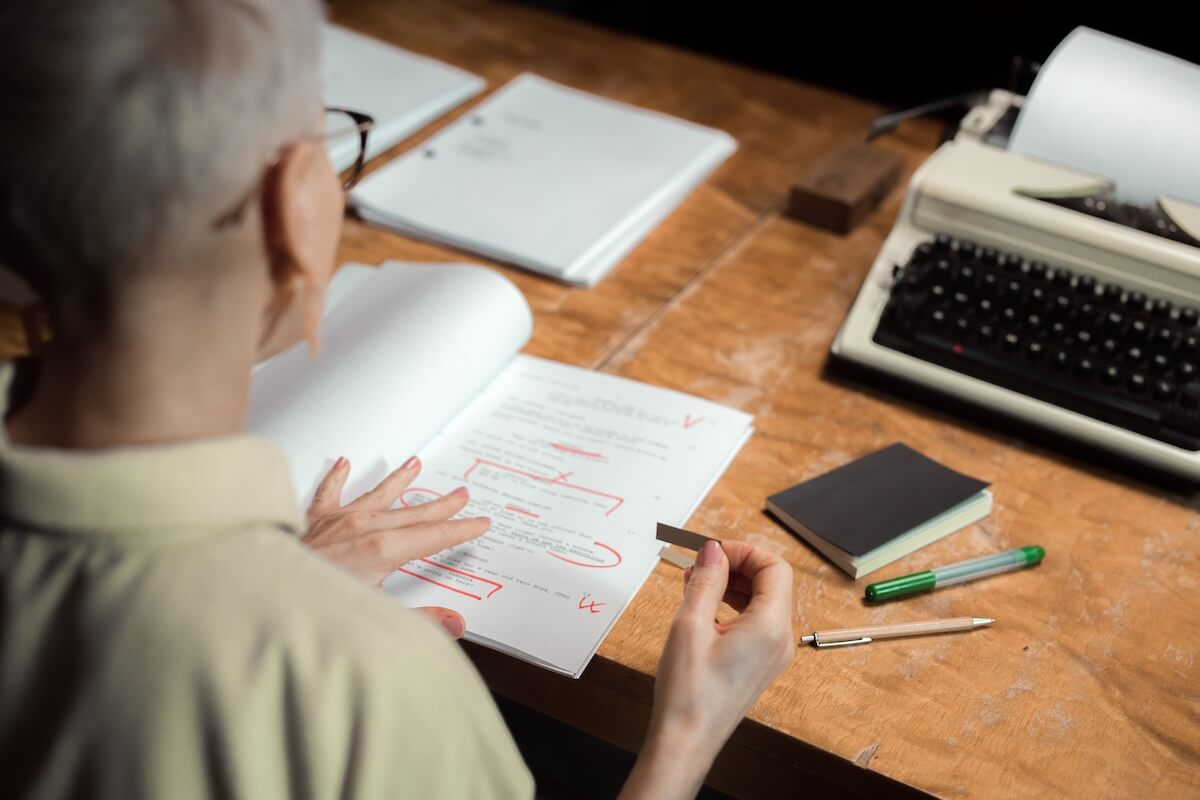
Finishing a first draft and starting revision are two completely different skills, and the most common mistake writers make in the transition is applying the wrong one: opening the manuscript at page one and starting to fix sentences, in order, from the beginning. That approach feels productive and is usually the least efficient way to revise a novel, because it fixes prose in scenes that might not survive a structural pass.
Let the Draft Rest First
Before doing anything else, put the draft down. A few weeks is a reasonable minimum; longer is often better. Distance is what lets you read your own manuscript the way a reader would, rather than the way you remember writing it. Revising immediately after finishing tends to produce edits based on what you meant rather than what’s actually on the page.
Revise in Passes, Big to Small
The efficient order is the reverse of how most writers instinctively start: structure first, then scene-level issues, then line-level prose, then proofreading last. Fixing a sentence in a scene that gets cut in the next pass is wasted work, and it happens constantly when writers start with line edits.
Pass 1: Structural
Read the whole manuscript, ideally in as few sittings as possible, taking notes rather than fixing anything. Questions worth asking:
- Does the structure actually work? Are the major beats (inciting incident, midpoint, climax) landing where they need to, and are they doing the job they need to do?
- Does the protagonist’s character arc track from beginning to end, with the change earned rather than sudden?
- Are there entire scenes, or subplots, that don’t earn their place? Cutting a subplot at this stage saves far more time than trimming it sentence by sentence later.
- Does anything happen too early or too late? Structural pacing issues (a saggy middle, a rushed ending) are usually visible at this level and invisible at the sentence level.
This pass often results in the most dramatic changes: cut chapters, reordered scenes, entire subplots removed or added. It’s uncomfortable precisely because the changes are large, but it’s far cheaper to make them now than after several rounds of line editing on material that ends up cut anyway.
Pass 2: Scene and Character
Once the structure holds, work scene by scene. This is where scene and sequel becomes a useful diagnostic: does each scene have a clear goal, real conflict, and a disaster that changes the character’s situation? Is dialogue doing real work, or is it filler? Are character motivations consistent with what you established in Pass 1?
Writing Desk tip: Run the novel editing AI’s developmental review after your structural pass, once the shape of the book is settled. It’s most useful here, checking scene-level logic and character consistency, rather than earlier when large sections might still be cut.
Pass 3: Line Editing
Only now does prose-level work make sense: sentence rhythm, word choice, tightening, cutting filler words and repeated tics. This is also the point to apply craft principles like show don’t tell at the sentence level, since you’re no longer at risk of polishing material that might not survive.
Pass 4: Proofreading
Grammar, spelling, consistency errors (a character’s eye colour changing between chapters, timeline errors). This is deliberately last, because there’s no point proofreading a scene that gets cut in an earlier pass.
Getting Outside Feedback
Beta readers or a critique partner are most useful after your own structural pass, not before. Sending out a draft you already know has structural issues wastes their time telling you what you already knew, and sending it out too early, before you’ve had any distance yourself, often produces feedback you’re not yet in a position to hear clearly.
Final Words
The instinct to start fixing sentences on page one is understandable; it feels like forward motion. But a first draft’s real problems are almost always structural, and structural problems are invisible at the sentence level. Read the whole thing first. Fix the shape. Then, and only then, make it sound good.
Related reading:
The writing app built for novelists.
Plot, draft, edit, and format your manuscript in one private, local app for Mac. Free to download. Your writing never leaves your machine.
macOS 13 Ventura or later · No account required