
Every story you love runs on a collision course. The characters want something, but something stands in the way. This is the core tension that gets you turning the pages. That collision is conflict, and as a writer knowing the different types and how to use conflict effectively gives you a set of tools you can leverage intentionally and to great effect.
This guide covers seven types of conflict seen in literature, with examples from classic and modern fiction, and explores how you can use each type in your own writing.
What is conflict in fiction?
Conflict can take many different forms. It could be a physical barrier or an emotional one. But the core of it is always the same, something stands in the way of the character getting what they want. A story needs these obstacles, because as soon as the character (be they the protagonist or the villain) does get what they want the tension dissolves.
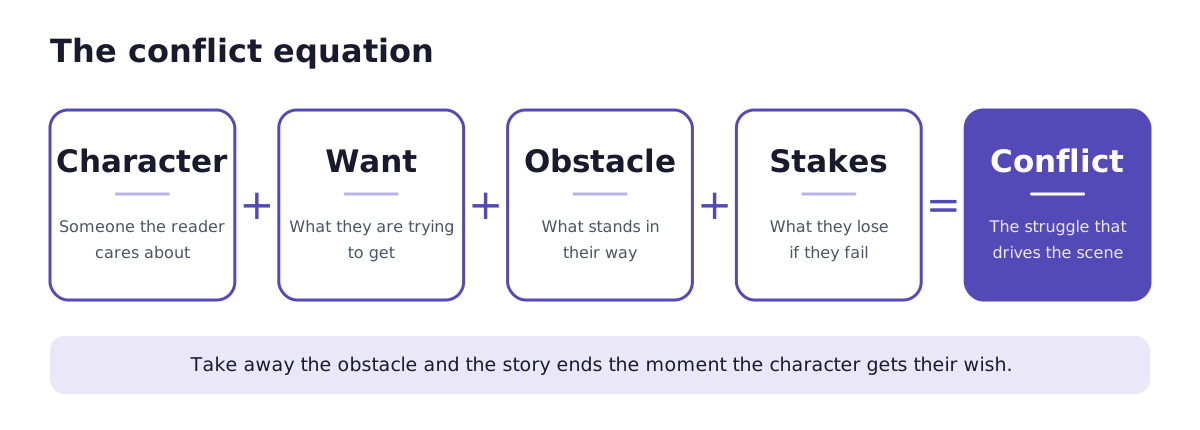
Conflict can be summed up with a simple equation: character + want + obstacle + stakes. The obstacle supplies the friction. The stakes tell the reader why the friction matters, and together they create tension.
A character who wants to cross a room faces no conflict. A character who wants to cross a room to stop their sister signing a document, with a hostile relative standing in the doorway, has a scene.
Conflict does three jobs at once:
- It drives the plot, because each obstacle forces a decision and each decision changes the situation.
- It reveals character, because people show who they are by what they choose under pressure.
- It carries theme, because what a story fights about is usually what it is about.
Internal and external conflict
Literary conflict falls broadly into two distinct families, external and internal conflict.
External conflict places the character against something outside themselves: another person, a society, a storm, a machine, a monster, a prophecy, etc. The character has to overcome a physical hurdle to progress.
Internal conflict takes place inside the character: a moral dilemma, a fear, a desire that contradicts another desire. The reader watches it through choices, hesitations and what the character says to themselves.
Six of the seven types below are external and one is internal. But you don’t have to choose just one type of conflict, often the strongest stories run an external conflict alongside an internal one. For example, the process of over-coming an external conflict could create an internal one because the character has to do something they are ashamed of.
The seven types of conflict in literature
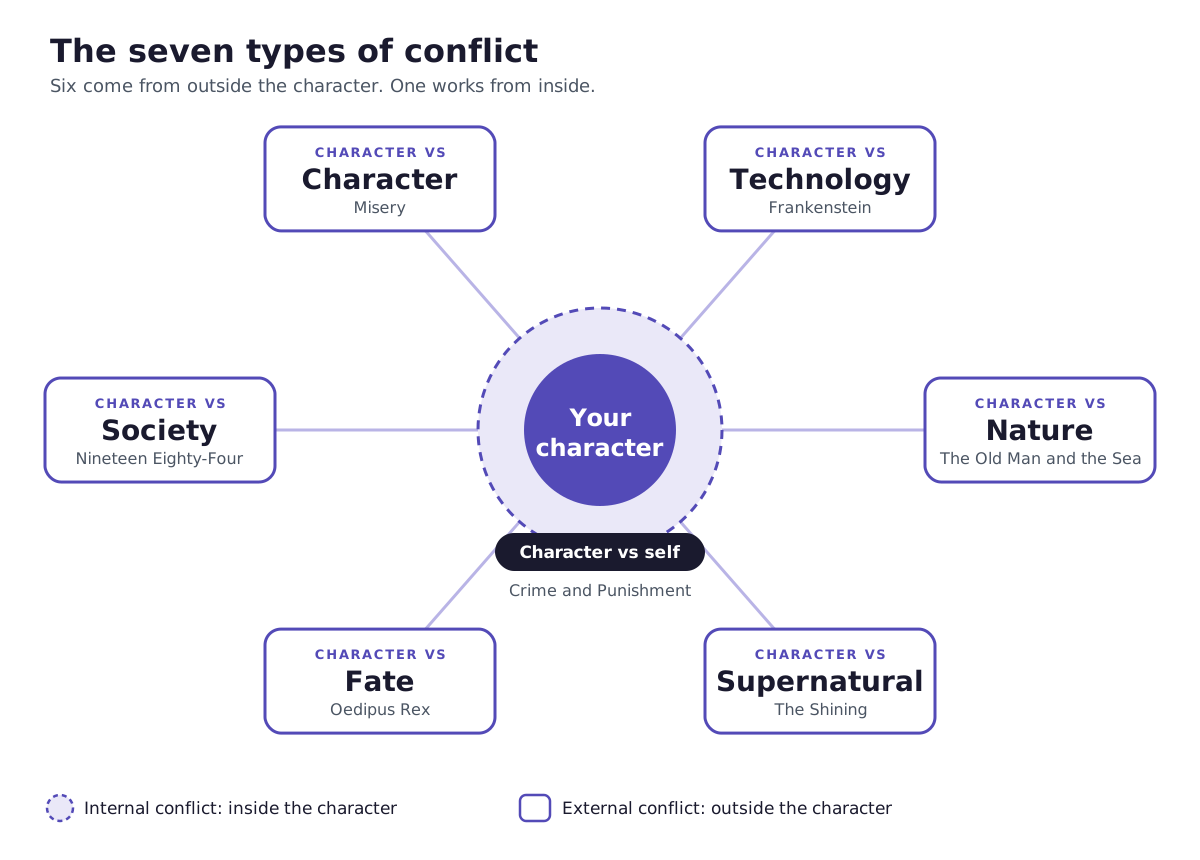
| Type | The character faces | Example |
|---|---|---|
| Character vs character | Another person | Misery |
| Character vs society | A group, system or culture | Nineteen Eighty-Four |
| Character vs nature | The natural world | The Old Man and the Sea |
| Character vs technology | A machine or invention | Frankenstein |
| Character vs supernatural | A force beyond natural law | The Shining |
| Character vs fate | A destiny that seems fixed | Oedipus Rex |
| Character vs self | Their own mind and values | Crime and Punishment |
1. Character vs character
This is the familiar protagonist and antagonist pairing, though it also covers rivals, family disputes and rocky romances. The two sides want things that cannot both happen.
In Stephen King’s Misery, the novelist Paul Sheldon wakes up injured and dependent on Annie Wilkes, a former nurse and devoted fan who wants him to write the book she demands. Their goals collide in a single room, and every scene between them is a negotiation over who controls the story.
Writing it well: Give the opposing character a want that makes sense from their side. A villain who believes they are right produces a better fight than one who exists to obstruct. Our guide to the antagonist and the foil character goes deeper on this.
2. Character vs society
Here the opposition is collective: a government, a school, a community, a set of unwritten rules or norms. Society presses the character to conform, and the character resists, adapts or ends up actually breaking the system.
George Orwell’s Nineteen Eighty-Four sets Winston Smith against the Party, which polices speech, history and even private thought. Harper Lee’s To Kill a Mockingbird sets Atticus Finch and his children against the settled prejudice of Maycomb, Alabama, most sharply when Atticus defends Tom Robinson at trial.
Writing it well: Make society specific and personal by showing it through individual people. A faceless system gives the reader nobody to dread. A neighbour, a teacher or an official gives the system a face.
3. Character vs nature
The opposition is the natural world: weather, wilderness, an ocean, a barren planet, a landscape after collapse. Nature has no motive and cannot be bargained with, which gives these stories a clean, physical tension.
Ernest Hemingway’s The Old Man and the Sea follows the fisherman Santiago through days of struggle with an enormous marlin and the sharks that follow. Cormac McCarthy’s The Road sends a father and son across a dead landscape where every day brings the problem of food, shelter and cold. Andy Weir’s The Martian leaves astronaut Mark Watney alone on Mars with limited supplies and a hostile environment, and the plot is his sequence of problems and solutions.
Writing it well: Research the specifics. Real survival details, real weather and real terrain make the danger credible. Resist the last-minute rescue too, since a deus ex machina ending undercuts the struggle you spent the book building. These stories also tend to expose an inner conflict, because a character alone against the elements has time to confront themselves.
4. Character vs technology
The opposition is a machine, an invention or a system the character built or depends on. These stories ask what happens when we lose control of the tools we create.
Mary Shelley’s Frankenstein follows Victor Frankenstein after he animates a creature he then abandons, and the consequences pursue him across Europe. In Arthur C. Clarke’s 2001: A Space Odyssey, the ship’s computer HAL 9000 turns on the crew it serves.
Writing it well: The most affecting versions give the technology a logic, reason, or motivation of its own, so the reader can follow why the machine acts as it does. The conflict deepens when the character carries some responsibility for what they built or trusted.
5. Character vs supernatural
The opposition is a ghost, demon, god, curse, monster or magical power: something that operates outside natural law. Fantasy and horror lean on this type heavily, though it appears in literary fiction too.
In The Shining by Stephen King, Jack Torrance takes a winter caretaking job at the Overlook Hotel, and the hotel’s malevolent presence works on him and his family. Bram Stoker’s Dracula gathers a group of ordinary people to face an ancient predator that their science and law cannot easily explain.
Writing it well: Set the rules of the supernatural force early and keep to them. Readers can and will accept a great deal, but the internal logic has to be consistent and hold up to scrutiny. Tension drains away when a threat can do anything at all. If you write fantasy, this is where world building supports plot directly, since the limits of your magic system define what your character can try.
For a starting spark, try our fantasy writing prompts or horror writing prompts.
6. Character vs fate
The opposition is a destiny that looks fixed: a prophecy, a curse, a family inheritance, a role the character did not choose. The question is whether the character can escape the path they are on, whether what has been foretold can be changed, whether the character even has free will.
In Sophocles’ Oedipus Rex, Oedipus learns that he is destined to kill his father and marry his mother, and the choices he makes to escape the prophecy carry him into it. In Shakespeare’s Macbeth, the witches’ prophecy sets the plot moving, and Macbeth’s attempts to secure it produce his ruin. Frank Herbert’s Dune gives Paul Atreides glimpses of a future he fears, and the novel tracks his struggle over how far he can steer away from it.
Writing it well: Decide what the prophecy or destiny demands, and let the character’s attempts to resist it generate the plot. The best versions keep the reader unsure until late whether resistance helps or hastens the outcome, which makes them a natural home for a well-built plot twist.
7. Character vs self
The opposition is inside the character: guilt, fear, addiction, ambition, a belief about themselves that is false, or two values pulling in different directions. This is the internal conflict, and it often sits alongside or underneath the other six.
In Dostoevsky’s Crime and Punishment, Raskolnikov commits murder convinced he has the right, then spends the novel unravelling under guilt and fear. In Ursula K. Le Guin’s A Wizard of Earthsea, the young wizard Ged releases a shadow into the world through his own pride, and the shadow turns out to be a part of himself he must face and name.
Writing it well: Dramatise the struggle through choices and consequences, since thought alone can stall a scene. Put the character in situations where the wrong decision tempts them and the right one costs them.
A character flaw gives you the raw material, and our guide to the character arc shows how inner conflict shapes change across a whole book.
How do the types of conflict work together?
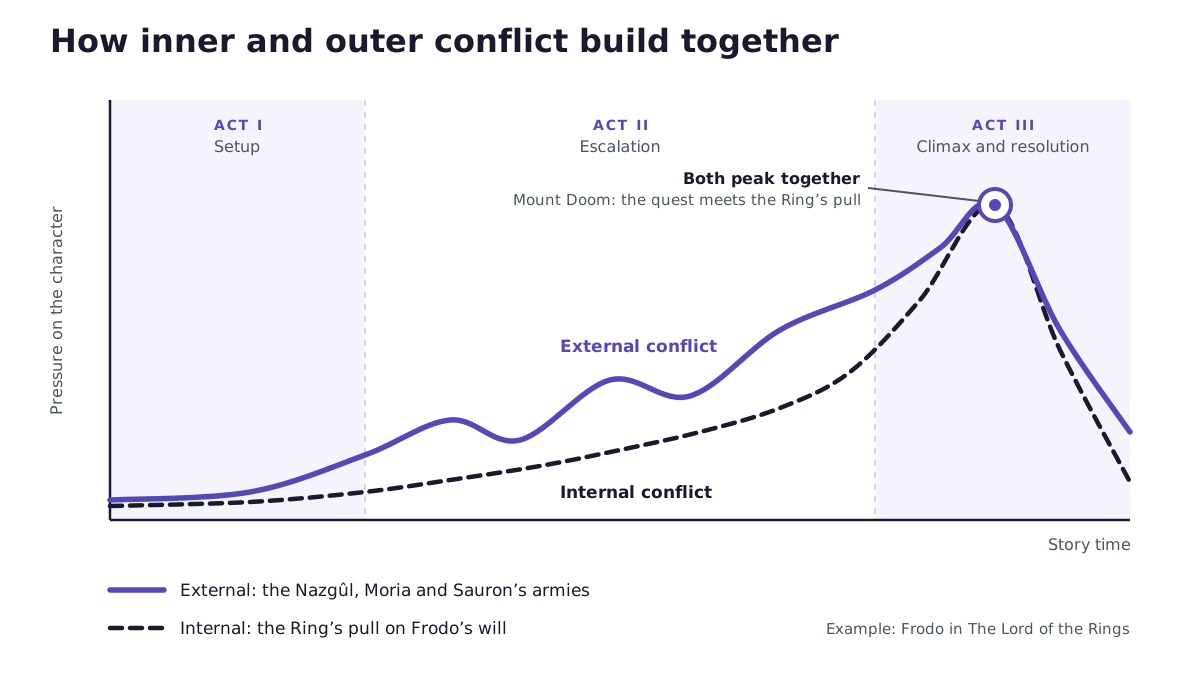
Memorable stories often run several types at once, and they tend to nest. An external conflict supplies pressure and an internal conflict supplies meaning.
- In The Lord of the Rings, Frodo faces the supernatural power of Sauron and the Ring, and he also faces the Ring’s pull on his own will. The outer quest and the inner struggle both matter, and each raises the cost of the other.
- In The Hunger Games, Katniss Everdeen faces a totalitarian society, rival tributes and the arena itself, while wrestling with what survival will ask her to do to other people.
- In Jane Austen’s Pride and Prejudice, Elizabeth Bennet faces the social expectations of her class and her conflict with Darcy, while having to question her own quick judgements.
A subplot gives you room to run a second or third conflict alongside the main one, which is how a long novel keeps its tension varied.
When you plan a story, a good test is to name one external conflict and one internal conflict and ask how they feed each other. If solving the outer problem would also resolve the inner one, you may have a plot and a character arc that talk to each other. If they run on separate tracks, the story can feel like two books.
How do you choose the right conflict for your story?
Start from your character and your genre, and work outwards.
- Start with what your character wants and fears. The opposition that hurts most presses on both. A character who craves approval fits naturally against a society that withholds it.
- Check the genre. Thrillers lean on character vs character, survival stories on nature, science fiction on technology, horror and fantasy on the supernatural. You can combine them and subvert them, and it helps to know the expectations first. Frameworks such as the three-act structure and the hero’s journey place major clashes at predictable points, which helps you decide where each type belongs.
- Raise the stakes in steps. Conflict that sits at one level for 80,000 words loses force. Plan how each type escalates through rising and falling action, so the character faces a harder version of the problem in each act, and watch your pacing so the pressure builds at a steady rate.
- Make the opposition active. Obstacles that only wait for the hero produce flat scenes. Give the opposing force its own plan, which the character must react to.
- Resolve it with a cost. An ending lands when the character pays something real to win, lose or change.
A conflict ladder for your next scene
Try this on a scene that feels flat. It takes about ten minutes.
- Write one sentence for what your point-of-view character wants in this scene.
- Write one sentence for what stands in their way, and name which of the seven types it is.
- Write one sentence for what happens if they fail.
- Add a second type of conflict, ideally an internal one, and write how it complicates their choice.
- Rewrite the scene’s opening line so it starts at the moment the pressure peaks.
A scene with one clear want, one clear obstacle and a visible cost has the structure it needs. If you cannot answer step three, the stakes may need raising. Our guide to scene and sequel shows how to follow a high-conflict scene with a beat that lets the character react and decide.
Tracking conflict across a whole manuscript
A novel carries many conflicts across many scenes, and it helps to see them in one place.
Writing Desk tip: The Story Plotter gives you eleven structure templates, including Three-Act, Hero’s Journey and the Save the Cat beat sheet, so you can place where each major conflict opens, escalates and resolves. The Resource Hub keeps your character and world notes beside the manuscript, which makes it easier to check that each antagonist, society or supernatural rule behaves consistently from chapter to chapter.
The tool matters less than the habit. A scene list with a conflict type and a stake beside each entry will show you where tension thins out long before a reader does.
Frequently asked questions
How many types of conflict are there in literature?
Sources vary. Some list six types and others seven, and the seven above are a common set. Some groupings fold fate into supernatural, and some add categories such as character vs group. All of them sort back into internal and external conflict.
What is the difference between internal and external conflict?
External conflict places a character against something outside themselves, such as a rival, a storm or a regime. Internal conflict happens within the character, such as a moral dilemma or a fear. Strong stories often combine both.
Can a story have more than one type of conflict?
Yes. A single plot can set a character against an antagonist, a society and their own doubts, as in The Hunger Games and Pride and Prejudice.
Which type of conflict is the easiest to write?
Character vs character is the easiest to spot and stage, because it needs only two people with opposed goals. Character vs self asks more of you as a writer, since the struggle has to show up through choices.
How do I know if my story has enough conflict?
Look at each scene and ask what the character wants, what blocks them and what they lose if they fail. A scene that cannot answer those questions is a candidate for cutting or reworking.
Where to go next
Conflict gives your plot its shape and your character their reason to change. Pick the conflict that hurts your character most, add a second one that pulls from the inside, and let each scene raise the cost. For more, browse our how to write a novel hub and the characters hub.
Writing Desk is a Mac writing app built for the whole life of a manuscript, from the first plot note to the finished book. Download Writing Desk free and map your story’s conflicts in the Story Plotter.
Related reading:
The writing app built for novelists.
Plot, draft, edit, and format your manuscript in one private, local app for Mac. Free to download. Nothing leaves your Mac unless you choose to sync it.
macOS 13 Ventura or later · No account required