
Chapter length is one of the few craft decisions you can feel working. Get it right and a reader says “just one more chapter” at midnight. Get it wrong and they drift off in the middle of a long one, or never build momentum through a run of tiny ones.
So how long should a chapter be? Any length works if it serves the story, and a handful of practical ranges will get you started. This guide covers those ranges, how they translate into pages and chapter counts, and the method I use for my own books.
How long should a chapter be?
For most fiction, aim for somewhere between 2,000 and 5,000 words. Reedsy’s analysis of 50 books across genres found average chapter lengths falling inside that range, and 3,000 words sits comfortably in the middle.
Genre pulls the number around. Thrillers lean towards shorter chapters that keep the pacing brisk. Fantasy leans longer, because readers expect room for world and character. Your own style and the needs of a particular scene matter more than either.
A useful way to think about it: a chapter is a unit of attention. You are deciding how much story a reader takes in before they get a natural place to pause.
How many pages is a chapter?
Print pages hold roughly 250 to 300 words, depending on trim size and font. That makes the conversion simple.
| Chapter word count | Approximate pages |
|---|---|
| 1,500 words | 5 to 6 pages |
| 2,000 words | 7 to 8 pages |
| 3,000 words | 10 to 12 pages |
| 4,000 words | 13 to 16 pages |
| 5,000 words | 17 to 20 pages |
If you are drafting in a manuscript, use word count as your measure. Page counts shift the moment you typeset the book.
How many chapters are in a novel?
Divide your target word count by your target chapter length. A few examples:
| Novel length | Chapter length | Chapters |
|---|---|---|
| 80,000 words | 3,000 words | about 27 |
| 90,000 words | 3,000 words | 30 |
| 100,000 words | 3,000 words | about 33 |
| 90,000 words | 2,000 words | 45 |
| 90,000 words | 4,000 words | about 22 |
The number is a planning tool. It tells you how many pieces you are building before you start, and it gives you a rhythm to write against. If you haven’t settled on a target word count yet, our guide to novel length is a good place to start.
My own chapter length
I aim for about 30 chapters of around 3,000 words each. Longer than that and I find a chapter starts to drag. Three thousand words gives a scene or two room to develop, and it ends before my attention wanders, which makes a decent stand-in for the reader’s.
When I write from several points of view, I let the chapter do the work of switching viewpoint. Each chapter belongs to one character and holds three scenes of roughly 1,000 words. Then I move to the next character and repeat, cycling through the cast. The arithmetic lands in the same place, 3,000 words a chapter, but the structure tells me exactly where each chapter starts and stops.
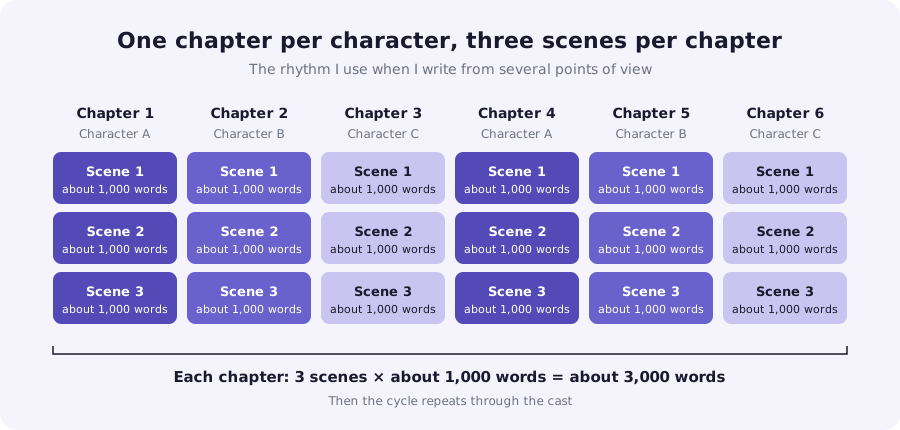
I treat all of this as flexible. If a scene wants 1,600 words, it gets 1,600. The target keeps the book moving, and the story decides the detail.
What if I don’t use chapters at all?
Some well-loved books manage without them. Terry Pratchett wrote most of his Discworld novels as a continuous run of scenes divided by line breaks, with chapters appearing in only a few later books such as Going Postal and Making Money. Ray Bradbury’s Fahrenheit 451 is divided into parts with no chapters.
Both show that the unit that matters is the scene. A chapter is a convenient way to bundle scenes, and some writers bundle one scene per chapter. If you prefer scenes without chapters, your breaks still need to do the same job: give the reader a place to pause and signal that something has shifted. Scene and sequel is a practical way to think about what each scene needs to contain.
How do I find the right chapter length for my book?
Try these checks on a draft chapter:
- Find the natural ending. Look for the point where a question is raised, a decision lands or a scene closes. Break there, and let the word count fall where it falls. Ending just before an answer lands is also a simple way to create tension.
- Notice where you skim. If you skim your own pages on a read-through, the chapter has probably run past its useful length.
- Read the shape of the whole book. Lay your chapter word counts side by side. A run of very short chapters builds speed. A long one slows the pace, so make sure the story earns it. Some novels vary length on purpose, with chapters that grow shorter as the tension rises. Our guide to rising and falling action shows where that tension tends to build and release.
- Match the chapter to its job. An action sequence and a quiet conversation need different amounts of room.
- Hold the number loosely during the first draft. Write the story first, then adjust break points when you revise your first draft.
How do I plan chapters before I draft?
Knowing your target chapter length and count turns a blank page into a map. If you work from a structure such as three-act structure or the Hero’s Journey, you can see roughly how many chapters each stage needs and where the big turning points will land. Starting from scratch? How to write a novel outline walks through the process. A 30-chapter book, for example, puts the first plot point around chapter 7 or 8 and the midpoint around chapter 15.
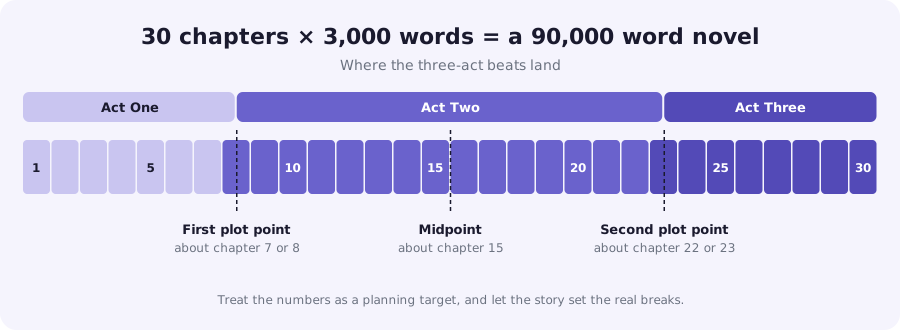
Writing Desk tip: The Story Plotter includes eleven structure templates, including Three-Act and Hero’s Journey, so you can place your major beats first and then divide the space between them into chapters. Your plot, chapters and notes sit together in one project.
Frequently asked questions
How many words should a chapter be?
Most fiction chapters land between 2,000 and 5,000 words, and 3,000 is a comfortable middle. Genre, pacing and the needs of the scene all move the number.
What is the average chapter word count?
Reedsy’s analysis of 50 books found averages between 2,000 and 5,000 words per chapter. Treat that as a starting range for planning.
How many pages should a chapter be?
At 250 to 300 words per printed page, a 3,000-word chapter runs 10 to 12 pages. Page count changes with trim size and typography, so plan in words.
How many chapters should a novel have?
Divide your target word count by your target chapter length. A 90,000-word novel with 3,000-word chapters has 30 chapters.
Do chapters have to be the same length?
No. Varying length changes the pace, and some books do it on purpose. A short chapter after a long one reads as a jolt.
Can a novel have no chapters?
Yes. Terry Pratchett’s Discworld novels mostly used scene breaks instead, and Fahrenheit 451 uses parts. Your breaks still need to give the reader somewhere to pause.
Final words
Pick a chapter length that suits the story you are telling, plan around it, and break the rule whenever a scene asks you to. Chapters exist so the story can breathe, so end each one where a reader would want to turn the page.
Related reading:
The writing app built for novelists.
Plot, draft, edit, and format your manuscript in one private, local app for Mac. Free to download. Nothing leaves your Mac unless you choose to sync it.
macOS 13 Ventura or later · No account required